.png)
Ad Relevance: Boosting E-Commerce ROI in 2026


Every British or Irish e-commerce business owner has seen ads miss the mark, leaving potential customers untouched and campaigns underperforming. The challenge lies in matching ad content with what shoppers truly want in the moment, not just relying on keywords or basic targeting. By focusing on ad relevance, you create advertising that feels personal and timely, improving user engagement and driving more meaningful results for your online store.
Table of Contents
Key Takeaways
Point | Details |
Significance of Ad Relevance | Aligning advertisements with user interests leads to improved engagement and a higher return on investment. |
Types of Ad Relevance | Utilising contextual, behavioural, demographic, temporal, and psychographic relevance enhances targeted campaign effectiveness. |
Impact on Campaign Performance | Ad relevance directly influences key metrics like engagement rates and conversion probabilities, critical for campaign success. |
Avoiding Common Pitfalls | Regular audits and updates of targeting strategies can prevent issues like static ad sequencing and content fatigue, ensuring ongoing effectiveness. |
What Is Ad Relevance and Why It Matters
Advertising relevance represents the strategic alignment between an advertisement’s content and the specific interests, needs, and context of the target audience. At its core, ad relevance determines how precisely an advertisement matches a potential customer’s current requirements or search intent.
The concept of ad relevance involves a complex, multidimensional assessment that goes far beyond simple keyword matching. Marketing science frameworks for adaptive ad sequencing demonstrate that effective relevance requires dynamic adjustments based on user behaviour and historical interaction data. This means modern ad relevance isn’t just about a one-time match, but maintaining sustained engagement over time.
Key components that contribute to high ad relevance include:
Precise audience targeting
Content personalisation
Contextual understanding
Temporal relevance
User behaviour analysis
Understanding ad relevance is critical for e-commerce businesses seeking to optimise their digital marketing strategies. Highly relevant advertisements can significantly improve engagement rates, reduce advertising costs, and increase overall return on investment. By focusing on contextual advertising principles, marketers can create more meaningful connections with potential customers.
Pro tip: Regularly analyse your ad performance metrics and audience interaction data to continuously refine and improve your ad relevance strategy.
Types of Ad Relevance in Digital Marketing
Digital marketing encompasses multiple sophisticated approaches to ad relevance, each designed to enhance user engagement and campaign effectiveness. Ad relevance types represent strategic methods for matching advertisements with user expectations and interests across various digital platforms.
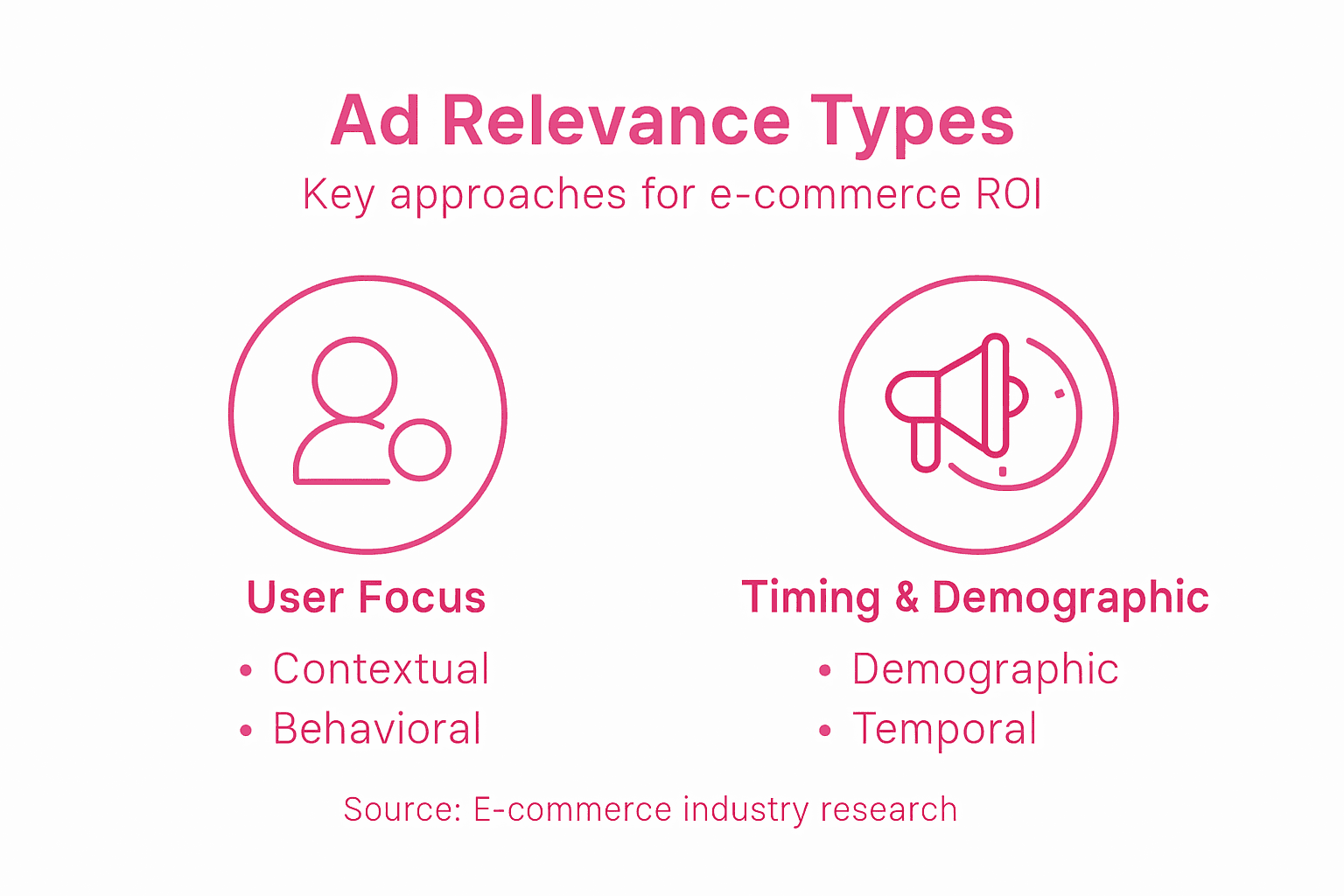
Positional ad relevance frameworks demonstrate how placement and context significantly impact an advertisement’s perceived value and potential interaction rates. These frameworks reveal that relevance is not a one-dimensional concept but a nuanced strategic approach involving multiple interconnected elements.
Key types of ad relevance include:
Contextual Relevance: Matching ads to webpage or search content
Behavioural Relevance: Targeting based on user’s previous online interactions
Demographic Relevance: Aligning ads with specific audience characteristics
Temporal Relevance: Adjusting ads based on time, season, or current events
Psychographic Relevance: Connecting with users’ interests, values, and lifestyle
Understanding these digital advertising types helps marketers create more sophisticated, targeted campaigns that resonate deeply with potential customers. By leveraging multiple relevance dimensions, businesses can significantly improve their advertising effectiveness and return on investment.
Here is a summary comparing major types of ad relevance in digital marketing:
Type of Relevance | Key Focus | Business Value |
Contextual | Matches ad to surrounding content | Increases engagement and recall |
Behavioural | Targets based on past actions | Boosts likelihood of conversion |
Demographic | Aligns with age, gender, etc. | Improves targeting effectiveness |
Temporal | Adapts to timing and seasons | Increases response rate |
Psychographic | Connects with lifestyle/interests | Deepens brand resonance |
Pro tip: Implement a multi-dimensional approach to ad relevance by combining different targeting strategies to create more compelling and personalised advertising experiences.
How Ad Relevance Influences Campaign Performance
Ad campaign performance is fundamentally driven by the strategic alignment between advertisement content and user expectations. Understanding how relevance impacts marketing outcomes is crucial for businesses seeking to maximise their digital advertising investments.

Advanced ad ranking methods demonstrate that relevance directly influences key performance indicators such as click-through rates, conversion rates, and overall return on investment. These sophisticated approaches reveal that adaptive ad sequencing can significantly enhance campaign efficiency across diverse user segments.
Critical performance metrics impacted by ad relevance include:
Engagement rates
Conversion probability
Cost per acquisition
User interaction duration
Brand perception and recall
The intricate relationship between relevance and performance is further illuminated by return on ad spend strategies that enable marketers to track and optimise their advertising effectiveness. By implementing data-driven relevance techniques, businesses can create more targeted, responsive campaigns that resonate deeply with their intended audience.
Pro tip: Continuously monitor and analyse your ad performance metrics, using real-time data to dynamically adjust your relevance targeting strategies.
Optimising Ad Relevance for E-Commerce Success
Ad relevance optimisation represents a critical strategy for e-commerce businesses seeking to maximise their digital marketing performance. By aligning advertisement content precisely with user expectations and behaviours, companies can significantly improve their online engagement and conversion rates.
Advanced ranking algorithms demonstrate that integrating customer behaviour predictions with relevance constraints can dramatically enhance product discovery and sales potential. These sophisticated approaches balance profitability metrics with user-centric targeting strategies, creating a more intelligent and responsive advertising ecosystem.
Key strategies for optimising ad relevance include:
Predictive behaviour analysis
Dynamic audience segmentation
Real-time intent tracking
Contextual content matching
Personalisation at scale
The implementation of responsive search ads enables marketers to create more adaptable and intelligent advertising approaches. By continuously refining targeting parameters and understanding nuanced user interactions, e-commerce businesses can develop more sophisticated, high-performing marketing campaigns that resonate deeply with their intended audience.
Pro tip: Implement machine learning algorithms to continuously analyse and adapt your ad relevance strategies, ensuring your targeting remains precise and effective.
Common Pitfalls and How to Avoid Them
Ad relevance strategies can quickly become ineffective when marketers fall into predictable traps that undermine their digital marketing efforts. Understanding these common pitfalls is crucial for developing robust and adaptive advertising approaches that genuinely connect with target audiences.
Domain adaptation techniques reveal several critical mistakes that e-commerce businesses frequently make when attempting to optimise their advertising relevance. These include overfitting targeting parameters, creating monotonous ad content, and failing to integrate profitability considerations into ranking algorithms.
Key pitfalls to watch for and mitigate include:
Narrow user data interpretation
Lack of audience diversity in targeting
Static ad sequencing
Ignoring user engagement patterns
Overlooking content fatigue
Disconnecting relevance from business objectives
By implementing responsive search ads, marketers can develop more dynamic and intelligent advertising strategies that adapt to changing user behaviours. This approach helps prevent stagnation and maintains high engagement levels by continuously refining targeting parameters and understanding nuanced user interactions.
Below is a comparison of strategies and pitfalls for optimising ad relevance:
Optimisation Strategy | Common Pitfall | Preventive Approach |
Predictive behaviour analysis | Narrow focus on limited user data | Broaden data sources |
Dynamic audience segmentation | Ignoring audience diversity | Regularly update segments |
Real-time intent tracking | Static ad sequencing | Implement adaptive sequencing |
Content personalisation at scale | Content fatigue in repeat exposure | Rotate creatives and messaging |
Pro tip: Conduct regular audits of your ad targeting strategies, using machine learning insights to identify and eliminate potential bias or performance limitations.
Elevate Your E-Commerce Strategy with Precision Ad Relevance
The challenge of boosting return on investment by mastering ad relevance is clear from the article. You need to overcome issues like static ad sequencing, content fatigue and narrow audience targeting while leveraging predictive behaviour analysis and real-time intent tracking. These key pain points mean that your digital marketing must be dynamic, personalised and data-driven to maximise engagement and conversions.
At IWantToBeSeen, we specialise in turning these concepts into actionable growth. With over 25 years of expertise scaling successful e-commerce brands, our tailored digital marketing services in SEO, AI, Social Media and PPC are designed to optimise your ad relevance. Explore how responsive search ads and advanced return on ad spend strategies can transform your campaigns and prevent common pitfalls identified in the article.
Ready to leave behind stagnant ads and unlock higher engagement?

Boost your e-commerce success today by partnering with a team that understands the critical link between ad relevance and campaign performance. Visit IWantToBeSeen now and start refining your ad strategy with industry-leading expertise.
Frequently Asked Questions
How does ad relevance impact e-commerce success?
Ad relevance is crucial for e-commerce success as it aligns advertisements closely with user expectations and behaviours, leading to improved engagement rates and conversion outcomes.
What are the types of ad relevance that marketers should consider?
Key types of ad relevance include contextual, behavioural, demographic, temporal, and psychographic relevance, each targeting different aspects of user engagement and interests.
What strategies can optimise ad relevance for my campaigns?
To optimise ad relevance, implement strategies such as predictive behaviour analysis, dynamic audience segmentation, and contextual content matching to create more tailored advertising experiences.
What common pitfalls should I avoid when optimising ad relevance?
Common pitfalls include narrow user data interpretation, static ad sequencing, and content fatigue. Regular audits and diversifying audience targeting can help mitigate these issues.
Recommended
Comments