.png)
Brand Lift: Driving e-Commerce Success Online


Most british e-commerce managers rely on conversion rates and click numbers, yet these alone miss how ads actually shape consumer perception. For businesses in the United Kingdom and Ireland, grasping brand lift is an essential step towards uncovering the psychological impact of digital campaigns. With brand recall driving nearly 40 percent of overall effectiveness in online advertising, you gain new clarity on how memorable your messages truly are—helping refine every marketing decision ahead.
Table of Contents
Key Takeaways
Point | Details |
Understanding Brand Lift | Brand lift is crucial for assessing the impact of advertising on consumer perception and behaviour beyond mere clicks or conversions. |
Key Metrics Identification | Metrics such as brand awareness and purchase intent offer valuable insights into advertising effectiveness throughout the consumer journey. |
Methodology Importance | Rigorous study designs and robust methodologies are essential to avoid biases and enhance the reliability of brand lift studies. |
Complementary Metrics | Brand lift and conversion metrics should be viewed as complementary tools for a nuanced understanding of marketing effectiveness. |
Brand lift defined for e-commerce
In the competitive world of digital marketing, brand lift represents a critical measurement strategy for understanding how advertising campaigns impact consumer perception and behaviour. Brand lift studies are sophisticated research methods designed to track psychological changes in target audiences after exposure to marketing communications.
The core purpose of brand lift measurement is to evaluate advertising effectiveness beyond traditional performance metrics like clicks or conversions. By comparing test groups who have seen an advertisement with control groups who have not, marketers can quantify nuanced shifts in brand awareness, perception, and purchase intent. These insights help businesses understand the deeper psychological impact of their marketing efforts.
Key brand lift metrics for e-commerce specifically include brand awareness, message association, ad recall, and potential purchase behaviour. Nielsen research indicates that brand recall alone accounts for almost 40% of brand lift effectiveness in digital channels, highlighting the importance of creating memorable advertising content that resonates with target audiences.
Pro tip: Track brand lift metrics consistently across different campaigns to build a comprehensive understanding of how your marketing messages influence consumer psychology and purchasing decisions.
Types of brand lift metrics and studies
Brand lift studies encompass a comprehensive range of metrics designed to measure the psychological impact of digital marketing campaigns. Key metrics span across multiple stages of the consumer journey, providing marketers with nuanced insights into advertising effectiveness.
These studies typically evaluate five primary metrics: brand awareness, brand perception, consideration, ad recall, and purchase intent. Brand awareness is further categorised into aided and unaided recognition, allowing marketers to understand how deeply their messaging penetrates consumer consciousness. Research from Eskimi demonstrates that these metrics can be measured through diverse methodological approaches, including traditional surveys, focus groups, third-party market research firms, and ongoing research panels.
Marketing professionals often segment brand lift studies according to different marketing funnel stages: upper funnel (awareness), middle funnel (consideration), and lower funnel (purchase intent). This stratified approach enables businesses to track specific psychological shifts triggered by advertising campaigns, moving beyond simplistic performance indicators like click-through rates or direct conversions.
Pro tip: Design your brand lift studies to track metrics consistently across different campaign iterations, enabling more precise longitudinal analysis of your marketing’s psychological impact.
How brand lift measurement works
Brand lift measurement is a sophisticated research methodology that provides marketers with deep insights into campaign effectiveness. The fundamental process involves dividing target audiences into two distinct groups: a test group exposed to advertising and a control group that receives no advertisement exposure.

The measurement process typically follows a structured approach. Researchers first design targeted advertising campaigns and randomly assign audience segments. After the test group experiences the advertisement, both groups undergo comprehensive surveys designed to capture nuanced shifts in brand perception. These surveys explore critical metrics including brand recognition, brand valuation, consumer familiarity, likelihood of recommendations, and potential purchase intent.
By systematically comparing the responses between test and control groups, marketers can precisely quantify the psychological impact of their advertising efforts. This approach transcends traditional performance metrics like direct sales or click-through rates, offering a more holistic understanding of how marketing communications influence consumer behaviour and brand perception. The comparative analysis reveals the incremental changes triggered by specific advertising interventions, enabling businesses to understand the true effectiveness of their marketing strategies.
Pro tip: Ensure your brand lift surveys include both quantitative and qualitative questions to capture comprehensive insights beyond numerical data.
Practical uses for digital campaigns
Brand lift measurement in digital campaigns offers e-commerce marketers a powerful toolkit for understanding and improving advertising effectiveness across multiple emerging media channels. This sophisticated approach provides actionable insights that go far beyond traditional performance metrics, enabling businesses to refine their marketing strategies with unprecedented precision.
The practical applications of brand lift studies are extensive and transformative. Marketers can use these insights to optimise ad creativity, fine-tune audience targeting, and craft more resonant messaging strategies. By systematically tracking shifts in consumer perception, businesses can make data-driven adjustments that enhance brand awareness, improve recall, and ultimately drive purchase intent across digital platforms.
In the dynamic world of e-commerce, brand lift studies serve as a critical diagnostic tool for understanding campaign performance. These studies help quantify the psychological impact of advertising by measuring nuanced changes in consumer attitudes and behaviours. This approach allows marketing teams to demonstrate tangible value to stakeholders, providing concrete evidence of campaign effectiveness that extends well beyond simple metrics like clicks or impressions.
This summary outlines the practical business impacts of implementing brand lift studies across digital campaigns:
Use Case | Impact on Business | Example Benefit |
Ad Creative Optimisation | Enhances consumer resonance | More memorable campaigns |
Audience Targeting | Increases relevance | Better segmentation results |
Stakeholder Reporting | Demonstrates value | Supports strategic decisions |
Cross-channel Insights | Improves multi-channel ROI | Unified marketing approach |
Employing brand lift studies yields benefits beyond basic performance tracking in e-commerce.
Pro tip: Integrate brand lift measurement consistently across different digital channels to develop a comprehensive understanding of how your marketing messages resonate with various audience segments.
Common mistakes and how to avoid them
Brand lift studies are prone to several critical methodological pitfalls that can compromise the reliability and validity of marketing insights. The most fundamental errors emerge from inadequate research design, including insufficient sample sizes, poorly constructed survey questions, and ineffective control group selection that can dramatically skew results.
Marketing professionals must be vigilant about potential biases and statistical limitations. Common mistakes often stem from misinterpreting data and overlooking contextual nuances that can lead to incorrect strategic decisions. Overreliance on vanity metrics, such as superficial engagement numbers, can create a misleading picture of campaign effectiveness, obscuring the deeper psychological shifts in brand perception.
To mitigate these risks, e-commerce marketers should adopt a rigorous, multi-dimensional approach to brand lift measurement. This involves carefully designing survey instruments, ensuring representative sampling, controlling for external variables, and interpreting results within a broader performance context. Sophisticated brand lift studies require a nuanced understanding of statistical methods, consumer psychology, and the specific dynamics of digital advertising channels.
Pro tip: Cross-validate your brand lift study results with multiple data sources and performance indicators to ensure a comprehensive and accurate interpretation of your marketing campaign’s true impact.
Comparing brand lift with conversion metrics
Brand lift metrics represent a fundamentally different approach to evaluating marketing performance compared to traditional conversion metrics. While conversion metrics focus exclusively on immediate, tangible outcomes like sales or click-through rates, brand lift explores the psychological landscape of consumer perception and potential future behaviours.
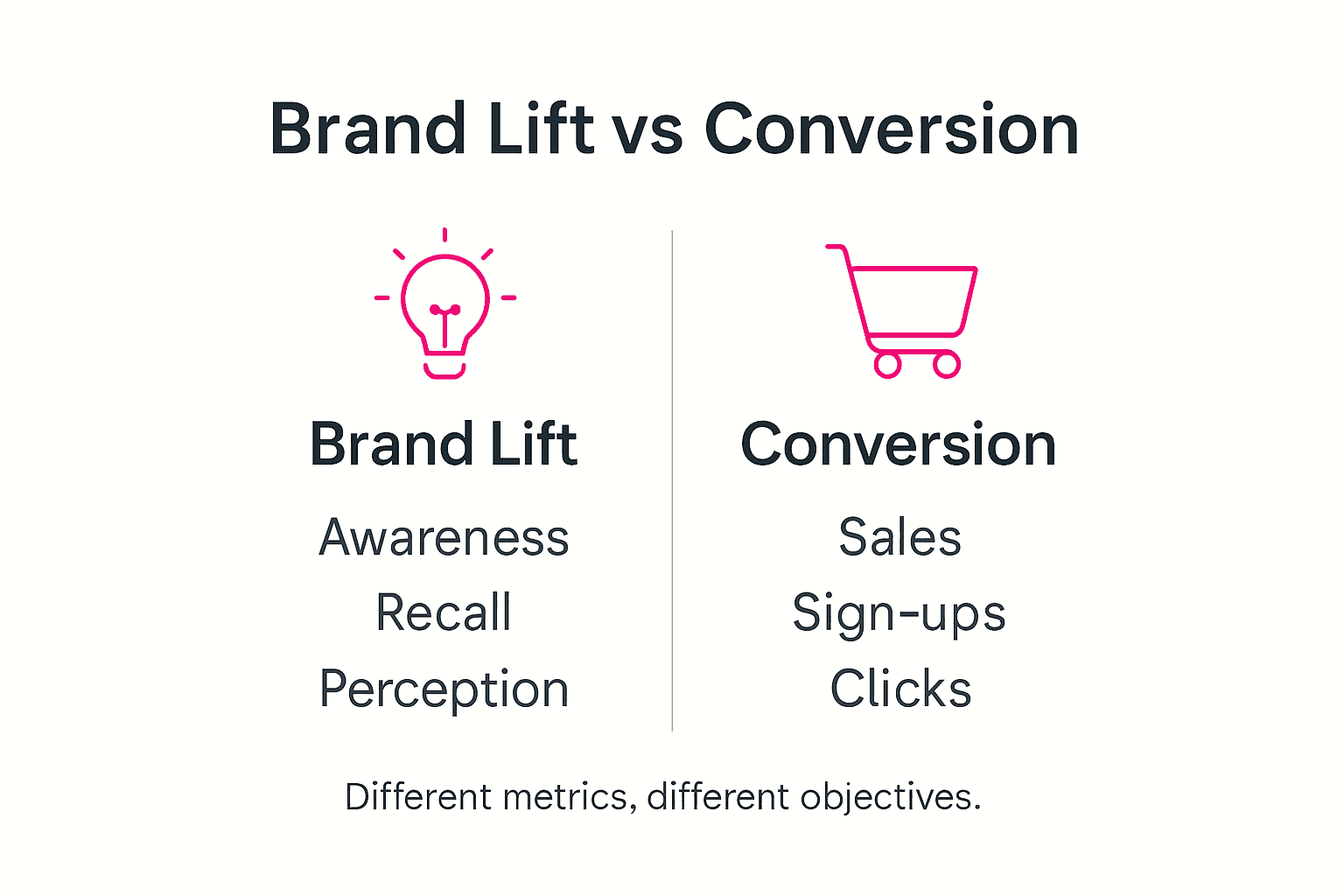
Here is a comparison between brand lift metrics and traditional conversion metrics in e-commerce marketing:
Aspect | Brand Lift Metrics | Conversion Metrics |
Focus | Consumer perception & psychology | Immediate sales & actions |
Measurement Outcome | Awareness, recall, purchase intent | Click-through rate, transactions |
Strategic Value | Drives long-term brand growth | Optimises short-term results |
Data Type | Survey, qualitative & quantitative | Web analytics, sales figures |
This overview highlights how each measurement approach addresses different marketing objectives.
The distinction between these measurement approaches is crucial for understanding holistic marketing effectiveness. Conversion metrics provide a snapshot of immediate transactional success, whereas brand lift insights delve into the deeper, often intangible shifts in consumer attitudes that can ultimately drive long-term business growth. These insights go beyond simple numerical indicators by examining factors such as brand recall, emotional resonance, and consumer relatability.
E-commerce marketers should view brand lift and conversion metrics as complementary rather than competing analytical frameworks. Conversion metrics offer direct performance evidence, while brand lift studies reveal the underlying emotional and perceptual changes that can predict future purchasing behaviours. By integrating these approaches, businesses can develop a more nuanced, comprehensive understanding of their marketing strategies’ true impact and potential.
Pro tip: Develop a holistic measurement strategy that combines conversion metrics with brand lift analysis to gain a 360-degree view of your marketing campaign’s effectiveness.
Elevate Your E-Commerce Brand with Expert Digital Marketing Services
Understanding and measuring brand lift is essential for e-commerce success. If you struggle to capture the true psychological impact of your advertising campaigns or want to move beyond basic conversion metrics to build lasting brand awareness and purchase intent, you are not alone. The article highlights how sophisticated brand lift studies reveal valuable consumer insights such as brand recall and perception that directly influence future buying behaviour.
At iWantToBeSeen, we specialise in tailored digital marketing solutions including SEO, AI-driven optimisation, Social Media management, and PPC campaigns designed to enhance brand awareness, ad recall, and purchase intent for e-commerce businesses. With over 25 years of experience scaling thriving online brands, we help you avoid common pitfalls of poor research design while unlocking the full potential of your digital campaigns.
Ready to transform your marketing strategy and see measurable psychological impact instead of only surface-level conversions?

Take the first step towards smarter brand lift measurement and genuine growth in your online store by contacting us today at iWantToBeSeen. Discover how our proven expertise can make your advertising campaigns more memorable and your audience targeting more precise.
Learn more about our comprehensive digital marketing services and start elevating your e-commerce brand now.
Frequently Asked Questions
What is brand lift in e-commerce?
Brand lift in e-commerce refers to the measurement of how advertising campaigns influence consumer perception and behaviour. It evaluates the effectiveness of marketing efforts beyond traditional metrics by assessing changes in brand awareness, perception, and purchase intent.
How does brand lift measurement work?
Brand lift measurement works by dividing audiences into a test group exposed to advertisements and a control group that is not. Surveys are then conducted to capture shifts in brand perception, enabling marketers to quantify the psychological impact of their campaigns.
What are the key metrics used in brand lift studies?
Key metrics in brand lift studies include brand awareness, ad recall, message association, brand perception, consideration, and purchase intent. These metrics help marketers understand how deeply their messaging resonates with consumers.
Why is brand lift measurement important for digital marketing?
Brand lift measurement is important because it provides insights into how effective marketing campaigns are in changing consumer attitudes and behaviours. This allows businesses to refine their strategies, enhance brand awareness, and ultimately drive higher purchase intent.
Recommended
Comments