.png)
Complete Guide to SEO for E‑Commerce


More than 90 percent of online experiences begin with a search engine, shaping how people find products, services, and information every day. For e-commerce businesses, understanding SEO is not just technical—it’s a vital part of reaching the right customers and standing out from the competition. This guide cuts through the confusion, explaining what SEO really is, why it matters for your business, and how it can transform your online presence.
Table of Contents
Key Takeaways
Point | Details |
Purpose of SEO | SEO enhances website visibility and ranking to connect potential customers with e-commerce platforms, driving organic traffic and reducing acquisition costs. |
Types of SEO | On-page, technical, off-page, local, and content SEO are essential for creating a comprehensive strategy that maximizes online performance. |
Implementation Steps | Effective SEO involves keyword research, content optimization, technical configuration, performance enhancements, and link building. |
Common Myths | Many businesses fall for myths like keyword stuffing; successful SEO requires a nuanced approach focusing on quality and user experience. |
What Is SEO And Its Purpose
Search Engine Optimization (SEO) is the strategic process of improving a website’s visibility and ranking within search engine results pages (SERPs). According to University of Maine, SEO involves increasing both the quality of website content and the number of clicks generated from search engines by understanding user search behaviour.
At its core, SEO is about connecting potential customers with your e-commerce platform through organic search results. This means optimizing your website’s content, structure, and technical elements to appear higher in search rankings when users look for products or services related to your business. Search engines like Google use complex algorithms that evaluate hundreds of factors to determine which websites are most relevant and authoritative for specific search queries.
The primary purposes of SEO for e-commerce businesses include:
Increasing organic website traffic
Improving brand visibility and awareness
Attracting high-intent potential customers
Reducing customer acquisition costs
Building long-term digital marketing credibility
As EDUCAUSE Review highlights, creating a strong web presence is crucial for establishing professional visibility. For e-commerce websites, this translates directly into potential sales and customer engagement. Effective SEO isn’t just about technical optimization - it’s about creating a seamless, user-friendly experience that search engines recognize and reward.
By implementing strategic SEO practices, e-commerce businesses can transform their online visibility, turning search engine results into powerful customer acquisition channels. Whether you’re a small startup or an established online retailer, understanding and executing SEO fundamentals can significantly impact your digital success.
Different SEO Types And Variations
According to Wikipedia, Search Engine Optimization encompasses several distinct types, each targeting different aspects of digital visibility. Understanding these variations is crucial for developing a comprehensive e-commerce SEO strategy that maximizes online performance and search engine rankings.
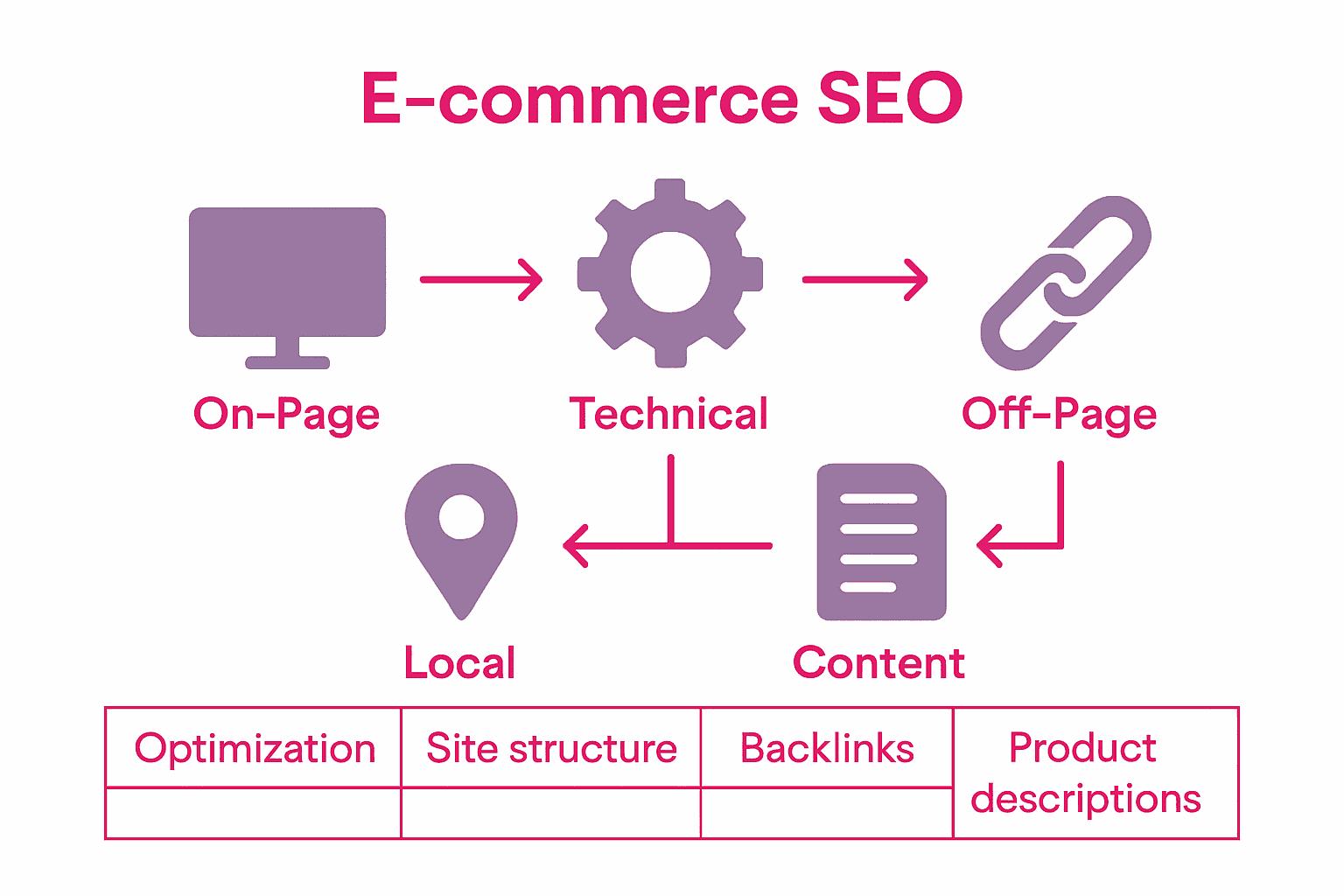
The primary SEO types for e-commerce businesses include:
On-Page SEO: Optimizing individual webpage elements like content, headers, images, and metadata
Technical SEO: Improving website infrastructure, loading speed, mobile responsiveness, and crawlability
Off-Page SEO: Building external signals like backlinks, social media mentions, and domain authority
Local SEO: Targeting geographically specific search results and improving location-based visibility
Content SEO: Creating high-quality, relevant content that addresses user search intent
As Wikipedia explains, search engine marketing (SEM) provides a broader context that includes both organic SEO strategies and paid advertising tactics. This means e-commerce businesses can leverage multiple approaches to enhance their digital presence. While organic SEO focuses on unpaid search results, paid strategies like Google Ads can complement these efforts by providing immediate visibility.
E-commerce websites must adopt a holistic approach, integrating different SEO variations to create a robust online marketing strategy. SEO Basics: Everything You Need to Know offers deeper insights into implementing these diverse optimization techniques effectively. By understanding and strategically applying these SEO types, online businesses can improve their search rankings, attract more targeted traffic, and ultimately drive higher conversion rates.
How SEO Works In Practice
According to Wikipedia, search engines utilize sophisticated crawlers that systematically explore and index web pages, evaluating numerous factors to determine search rankings. These digital robots analyze everything from content relevance and keyword usage to site structure and user experience, creating a complex algorithm that decides which websites appear most prominently in search results.
The practical implementation of SEO for e-commerce websites involves several critical steps:
Keyword Research: Identifying terms potential customers use when searching for products
Content Optimization: Creating high-quality, relevant content that matches search intent
Technical Configuration: Ensuring website infrastructure supports easy crawling and indexing
Performance Optimization: Improving site speed, mobile responsiveness, and user experience
Link Building: Developing a network of credible external references to enhance domain authority
A comprehensive website audit provides the foundation for understanding and improving SEO performance. This detailed analysis helps e-commerce businesses identify technical issues, content gaps, and optimization opportunities that might be limiting their search engine visibility. By systematically addressing these elements, online stores can progressively improve their search rankings and attract more organic traffic.

To truly excel in SEO, e-commerce businesses must adopt a holistic approach that combines technical excellence with user-focused content strategies. What Is an SEO Audit? Complete Deep Dive Guide can help you understand how to conduct a thorough evaluation of your website’s SEO potential. Remember, SEO is not a one-time task but an ongoing process of refinement, testing, and adaptation to evolving search engine algorithms and user behaviors.
Key Elements That Define SEO
According to Wikipedia, the key elements that define SEO encompass a complex ecosystem of technical, content, and strategic components that collectively determine a website’s search engine performance. These foundational elements work together to signal a site’s relevance, authority, and user value to search engine algorithms.
The primary key elements of SEO for e-commerce websites include:
Keyword Optimization: Strategically incorporating relevant search terms
Content Quality: Creating comprehensive, valuable, and original content
Technical Performance: Ensuring fast loading speeds and robust website infrastructure
User Experience: Designing intuitive navigation and mobile-friendly interfaces
Backlink Profile: Building a network of high-quality, relevant external references
Metadata Optimization: Crafting precise page titles, descriptions, and header tags
A comprehensive website audit becomes crucial in systematically evaluating these key SEO elements. This detailed assessment helps e-commerce businesses identify strengths, weaknesses, and opportunities for improving their search engine visibility. By meticulously addressing each element, online stores can create a robust SEO strategy that enhances organic search performance.
To gain deeper insights into specialized SEO strategies, Mobile SEO: Complete Guide for eCommerce Owners offers an excellent resource for understanding how specific optimization techniques can elevate your e-commerce platform’s digital presence. Remember, SEO is an intricate balance of technical precision, content excellence, and strategic thinking that requires continuous learning and adaptation.
Common SEO Myths And Pitfalls
According to Wikipedia, many e-commerce businesses fall prey to persistent SEO myths that can significantly undermine their digital marketing efforts. The most dangerous misconception is believing that simple tactics like keyword stuffing or over-optimizing meta tags can magically improve search rankings, when in reality, search engines demand a much more nuanced and comprehensive approach.
Common SEO myths that can harm e-commerce websites include:
Keyword Density Myth: Believing more keywords mean better rankings
Quick Fix Fallacy: Expecting instant results from minimal optimization
Quantity Over Quality: Prioritizing content volume instead of relevance
Ignore Technical SEO: Underestimating the importance of website infrastructure
Backlink Quantity Trap: Accumulating low-quality links instead of authoritative references
A comprehensive website audit can reveal critical SEO pitfalls that often go unnoticed. These hidden issues like broken links, duplicate content, and slow page speeds can dramatically reduce search engine performance. Most e-commerce businesses unknowingly sabotage their own visibility by neglecting these fundamental technical elements.
For e-commerce entrepreneurs seeking to navigate the complex world of SEO, Marketplace SEO: Everything You Need to Know provides valuable insights into avoiding common mistakes. Remember, successful SEO is about consistent, strategic effort rather than chasing quick shortcuts or believing in magical solutions that promise overnight success.
Practical SEO Implications For Owners
According to EDUCAUSE Review, establishing a professional online presence is critical for modern e-commerce businesses. SEO is no longer just a technical exercise but a strategic approach that directly impacts a company’s bottom line, requiring owners to think beyond simple website optimization and understand the deeper implications of digital visibility.
Key practical SEO implications for e-commerce owners include:
Resource Allocation: Understanding the time and budget required for effective SEO
Strategic Content Planning: Creating targeted, valuable content that drives organic traffic
Continuous Learning: Staying updated with evolving search engine algorithms
Performance Tracking: Implementing robust analytics to measure SEO effectiveness
Competitive Analysis: Monitoring and adapting to competitors’ digital strategies
As University of Maine emphasizes, successful SEO hinges on understanding user search behavior and crafting clear, concise content that directly addresses potential customer needs. This means e-commerce owners must develop a deep understanding of their target audience’s search patterns, preferences, and pain points.
To gain broader insights into digital marketing strategies that complement SEO efforts, 7 Essential Types of Digital Marketing for Ecommerce Success offers a comprehensive overview. Remember, effective SEO is a marathon, not a sprint – it requires patience, strategic thinking, and a willingness to continuously adapt and improve your digital approach.
Elevate Your E-Commerce SEO With Expert Guidance
Struggling with complex SEO challenges like technical performance, keyword optimisation and backlink quality can feel overwhelming, especially when your goal is to boost your online visibility and attract high-intent customers. This guide highlights the need for a comprehensive, ongoing SEO strategy that blends technical excellence and user-focused content. Without expert support, achieving consistent growth and long-term success might seem out of reach.

Unlock your e-commerce website’s full potential by partnering with seasoned professionals who bring over 25 years of experience scaling successful online brands. At iWantToBeSeen, we specialise in digital marketing services focussed on SEO, AI, Social Media and PPC tailored for e-commerce. Don’t wait for competitors to leave you behind. Start transforming your search engine rankings today with our proven strategies and personalised approach. Visit us now at https://iwanttobeseen.online and discover how our SEO Basics Guide and What Is an SEO Audit? Complete Deep Dive Guide can give your online business the advantage it deserves.
Frequently Asked Questions
What is SEO and why is it important for e-commerce?
SEO, or Search Engine Optimization, is the process of improving a website’s visibility in search engine results. For e-commerce, SEO is crucial as it helps attract organic traffic, improve brand visibility, and reach potential customers effectively.
What are the main types of SEO for e-commerce businesses?
The primary types of SEO for e-commerce include On-Page SEO (optimizing webpage elements), Technical SEO (improving website infrastructure), Off-Page SEO (building external signals), Local SEO (targeting specific geographies), and Content SEO (creating relevant content).
How does keyword research impact SEO for e-commerce?
Keyword research is vital for identifying the terms your potential customers use. By optimizing content around these keywords, e-commerce sites can better align with user search intent, improving their chances of ranking higher in search results.
What are common SEO pitfalls that e-commerce businesses should avoid?
Common SEO pitfalls include over-optimizing for keywords, neglecting technical SEO, focusing on low-quality backlinks, and underestimating the importance of a fast-loading website. A comprehensive website audit can help identify these issues.
Recommended
Comments