.png)
Conversion Funnel Optimization for Increased Ecommerce Sales


Many Ecommerce managers in the United Kingdom and Ireland recognise the frustration of seeing promising shoppers abandon their baskets just before checkout. Understanding why customers drop off at different funnel stages matters because even small barriers can mean missed sales and weaker retention. By applying conversion funnel analysis techniques and mapping each touchpoint, you gain the clarity needed to identify friction, refine the buyer journey and unlock consistent growth.
Table of Contents
Quick Summary
Key Point | Explanation |
1. Identify conversion barriers | Track user behaviour to find obstacles in the purchasing process that could hinder sales. |
2. Map customer journey touchpoints | Understand each interaction to enhance customer experience from awareness to purchase. |
3. Implement targeted enhancements | Use data-driven strategies to personalise experiences and address journey challenges. |
4. Test and analyse funnel improvements | Conduct systematic testing to uncover data insights that enhance performance. |
5. Monitor ongoing funnel performance | Maintain performance tracking to swiftly address emerging trends and optimise strategies. |
Step 1: Identify conversion barriers within your funnel
Understanding where and why potential customers abandon their purchasing journey is critical for improving your e-commerce sales performance. By carefully examining your conversion funnel, you can pinpoint specific obstacles preventing shoppers from completing their transactions.
To systematically identify conversion barriers, utilise comprehensive conversion funnel analysis techniques. This involves tracking user behaviour across multiple touchpoints and examining quantitative and qualitative data. Key areas to investigate include:
Site loading speed and overall technical performance
Mobile responsiveness and cross-device user experience
Clarity and positioning of calls-to-action
Product page design and information presentation
Checkout process complexity
Payment method options
Analytical tools like session recordings, heatmaps, and customer journey tracking can reveal precise drop-off points. By mapping where users exit your funnel, you can develop targeted strategies to reduce friction and improve conversion rates.
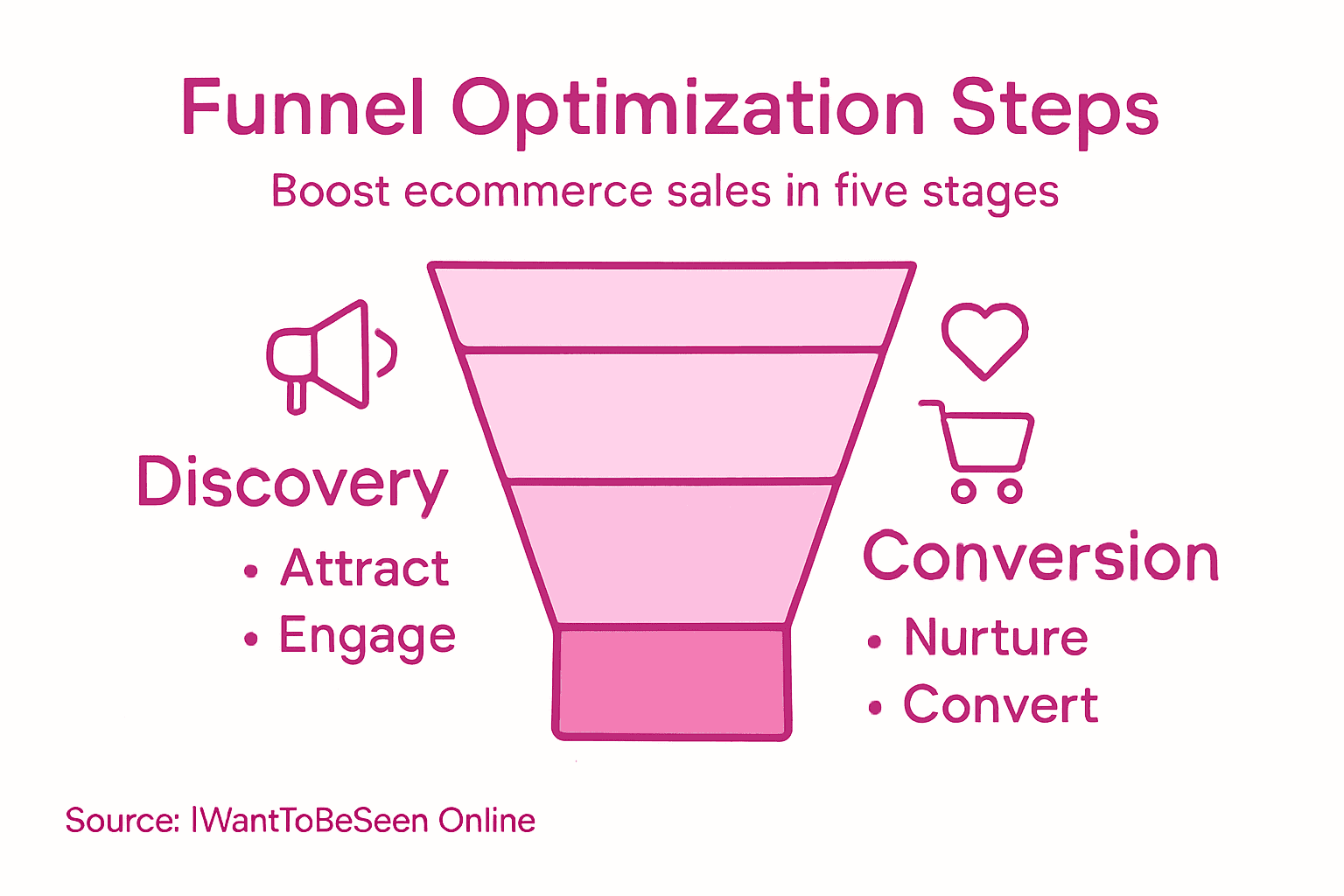
Here’s a concise summary of common funnel barriers and their business impact:
Conversion Barrier | Business Impact | Optimisation Priority |
Slow site loading | Lower conversions | High |
Unclear calls-to-action | Missed sales opportunities | Medium |
Complex checkout process | Increased abandonment | High |
Limited payment options | Fewer completed purchases | Medium |
Poor mobile experience | Reduced mobile sales | High |
Critical insight: Most conversion barriers are subtle - small improvements can yield significant sales increases.
Expert tip: Conduct monthly funnel audits and use A/B testing to continuously optimise your e-commerce customer journey.
Step 2: Map customer journey touchpoints
Successfully mapping your e-commerce customer journey requires a comprehensive understanding of every interaction point between your potential buyers and your online business. The goal is to create a detailed, strategic overview of how customers move through your sales funnel from initial awareness to final purchase.
To develop an effective journey map, leverage advanced AI-driven mapping techniques that capture interactions across multiple channels. Your mapping process should include tracking and analysing key touchpoints such as:
Website landing pages
Product category browsing
Individual product page interactions
Shopping cart engagement
Checkout process stages
Post-purchase communication
Customer support interactions
Email marketing touchpoints
Social media engagement
Each touchpoint represents an opportunity to understand customer behaviour, preferences, and potential barriers. By creating a comprehensive framework that tracks antecedents, mediators, and outcomes, you can develop a nuanced view of your customer’s experience.

To clarify the role of key customer journey touchpoints, here’s a reference table:
Touchpoint | Purpose | Optimisation Focus |
Landing page | Initial impression | Relevance and clarity |
Product page | Information & persuasion | Visuals and details |
Cart | Purchase intent | Trust and usability |
Checkout | Transaction completion | Friction reduction |
Post-purchase contact | Retention and loyalty | Personalisation |
Critical insight: Every touchpoint is a chance to either enhance or potentially disrupt the customer’s purchasing journey.
Expert tip: Regularly update your journey map and use cross-channel data to ensure a dynamic and accurate representation of customer interactions.
Step 3: Implement targeted funnel enhancements
Optimising your e-commerce conversion funnel requires strategic, data-driven interventions that personalise user experiences and address specific customer journey challenges. The key is transforming generic interactions into tailored, compelling engagement points that smoothly guide potential buyers towards purchase.
Leverage personalised recommendation systems powered by deep neural networks to enhance your funnel performance. These advanced techniques allow you to create microsegmented experiences that dramatically improve conversion potential. Critical enhancement strategies include:
Personalised product recommendations
Dynamic content adaptation
Contextual user experience design
Intelligent pricing strategies
Targeted email marketing sequences
Simplified checkout processes
Behaviour-triggered interventions
Precision retargeting campaigns
Your enhancement approach should focus on reducing friction and increasing relevance at every stage. This means understanding individual customer preferences, predicting potential drop-off points, and proactively addressing potential barriers before they impact conversion rates.
Critical insight: Successful funnel enhancements are about creating seamless, intuitive experiences that feel personalised to each customer.
Expert tip: Continuously monitor and test your funnel enhancements, using real-time data to iterate and refine your strategies for maximum effectiveness.
Step 4: Test and analyse funnel improvements
Transforming your e-commerce conversion funnel from good to exceptional requires systematic testing and rigorous data analysis. By implementing targeted measurement techniques, you can uncover precise insights that drive meaningful performance improvements across your customer journey.
Data-driven methods for detecting customer transitions provide crucial intelligence about user engagement and conversion potential. Your testing approach should encompass multiple analytical strategies, including:
Quantitative performance metrics
Statistical significance testing
User behaviour tracking
Conversion rate comparisons
A/B experimental designs
Multivariate testing protocols
Predictive analytics models
Real-time performance monitoring
Each testing iteration offers an opportunity to refine your understanding of customer interactions, identify friction points, and develop increasingly sophisticated engagement strategies. The goal is not just incremental improvement, but continuous optimization that adapts to evolving user expectations and market dynamics.
Critical insight: Successful funnel analysis transforms raw data into actionable strategies that directly impact revenue generation.
Expert tip: Schedule monthly comprehensive funnel reviews, ensuring you maintain a dynamic and responsive approach to conversion rate optimization.
Step 5: Monitor ongoing funnel performance
Sustaining e-commerce success requires continuous performance tracking and strategic monitoring. Your funnel’s health depends on understanding detailed metrics and responding swiftly to emerging trends and potential bottlenecks.
Centralized automated monitoring processes enable transparent assessment of marketing and sales activities across multiple channels. Your comprehensive monitoring strategy should incorporate:
Real-time performance dashboards
Conversion rate tracking
Customer segmentation analysis
Behavioural trend identification
Channel-specific performance metrics
Long-term retention indicators
Comparative historical data analysis
Predictive performance modelling
Effective monitoring transcends simple data collection. It requires developing a nuanced understanding of how different metrics interconnect, revealing deeper insights about customer behaviour and potential optimization opportunities. This holistic approach allows you to anticipate challenges and proactively refine your conversion strategies.
Critical insight: Continuous monitoring transforms raw data into a strategic asset for ongoing business growth.
Expert tip: Create automated weekly performance reports that highlight key funnel metrics, ensuring immediate visibility into critical performance indicators.
Drive Your Ecommerce Success with Expert Conversion Funnel Optimisation
The challenge of overcoming conversion barriers and enhancing every customer touchpoint can feel overwhelming. This article highlights critical pain points such as slow site loading, complex checkout processes and unclear calls-to-action that silently erode your sales potential. With over 25 years of experience scaling successful e-commerce brands, we understand how vital it is to implement personalised, data-driven strategies that reduce friction and maximise customer engagement.
Our specialised digital marketing services at IWantToBeSeen Online combine SEO, AI-powered insights, and targeted PPC campaigns designed to transform your funnel into a seamless journey. From optimising landing pages to delivering intelligent retargeting, we help you seize every opportunity discovered through rigorous funnel analysis and customer journey mapping.
Are you ready to eliminate hidden conversion blockers and unlock your e-commerce growth potential?

Take control of your funnel optimisation today with proven strategies by partnering with us at IWantToBeSeen Online. Discover how our expertise can turn insights into revenue by visiting our landing page now and start transforming your e-commerce sales funnel into a powerhouse of conversions.
Frequently Asked Questions
What are common conversion barriers in an e-commerce funnel?
Common conversion barriers include slow site loading, unclear calls-to-action, complex checkout processes, limited payment options, and poor mobile experiences. To improve sales, analyse your funnel and identify these barriers to take targeted actions that can enhance user experience within 30–60 days.
How can I effectively map my e-commerce customer journey?
To map your e-commerce customer journey, identify key touchpoints such as landing pages, product pages, the checkout process, and post-purchase interactions. Create a visual representation and track user interactions at each stage to pinpoint areas for improvement, ensuring you have a clear overview of the entire customer experience.
What strategies can I implement to enhance my conversion funnel?
Implement personalised product recommendations, simplify your checkout processes, and optimise your calls-to-action. Focus on tailoring experiences based on user behaviour, which can lead to a significant increase in conversion rates within a short timeframe.
How often should I test and analyse my funnel improvements?
You should conduct funnel testing and analysis monthly to continuously refine your approach. Regular testing, such as A/B testing, helps you understand what works and allows you to optimise for better customer engagement, resulting in smoother conversion processes.
What metrics should I monitor for ongoing funnel performance?
Monitor metrics such as conversion rates, customer segmentation analysis, and channel-specific performance indicators. By keeping track of these metrics and creating automated performance reports, you can quickly identify trends and make informed adjustments to enhance sales performance.
Recommended
Comments