.png)
Customer Experience Management: Driving Loyalty in Ecommerce


Every ecommerce manager knows the frustration when a promising visitor leaves without making a purchase. For brands in the United Kingdom and Ireland, designing a seamless customer journey is not just about convenience but about building lasting relationships. By mastering customer experience management, you can transform fleeting interactions into loyal customers and consistent sales, tapping into proven frameworks that cover satisfaction, trust, and the full multi-touchpoint journey.
Table of Contents
Key Takeaways
Point | Details |
Effective Customer Experience Management | Ecommerce brands must implement a strategic approach to transform casual browsers into loyal customers by enhancing every customer interaction with their platforms. |
Tailored CXM Solutions | Solutions for customer experience must be customised to fit specific customer segments and organisational goals, ensuring they address unique needs effectively. |
Integration of CXM and CRM | Combining Customer Experience Management with Customer Relationship Management is vital for creating a comprehensive engagement model that enhances customer loyalty and satisfaction. |
Continuous Improvement | Regularly conducting customer journey mapping and feedback loops is essential to refine strategies and maintain relevance in a dynamic digital landscape. |
Customer experience management for ecommerce brands
Customer experience management represents a strategic approach for ecommerce brands to understand, design, and optimise every interaction customers have with their online platforms. By implementing a comprehensive framework, brands can transform casual browsers into loyal customers who consistently choose their digital storefront.
Research highlights the critical components of effective customer experience management. Comprehensive conceptual models demonstrate that successful strategies encompass multiple interconnected constructs including:
Satisfaction tracking
Trust building mechanisms
Security protocols
Service quality standards
Perceived value assessment
Successful ecommerce brands recognise that customer experience extends far beyond a single transaction. Conceptual frameworks reveal that managing customer interactions requires a holistic approach across multiple touchpoints in the customer journey.
The most effective customer experience strategies involve proactively mapping and understanding each stage of customer interaction, from initial website visit through post-purchase support. This means creating seamless, personalised experiences that anticipate customer needs and reduce friction at every potential point of frustration.
Pro tip: Invest in advanced analytics tools that track customer behaviour across different touchpoints to continuously refine and personalise your online experience.
Types of customer experience management solutions
Customer experience management solutions have evolved dramatically, offering ecommerce brands sophisticated approaches to understanding and enhancing customer interactions. Comprehensive research demonstrates that these solutions can be categorised into distinct strategic archetypes designed to meet varying organisational needs and customer expectations.
Primary types of customer experience management solutions include:
Relieving solutions: Focused on reducing customer friction and resolving pain points quickly
Enabling solutions: Providing tools and resources that empower customers to achieve their goals
Enriching solutions: Creating additional value beyond core transactional experiences
Technological enablement solutions: Leveraging digital platforms to streamline interactions
Multi-touchpoint integration solutions: Creating seamless experiences across different channels
Multi-functional customer journey strategies reveal that successful solutions require cross-functional collaboration and strategic alignment. This means breaking down traditional departmental silos and creating integrated approaches that prioritise holistic customer experiences.
Successful ecommerce brands recognise that these solutions are not one-size-fits-all. Each solution must be carefully tailored to match specific customer segments, technological capabilities, and organisational objectives. By understanding the nuanced differences between various customer experience management approaches, businesses can design more targeted and effective strategies.
Pro tip: Conduct regular customer journey mapping to identify which customer experience management solution will be most effective for your specific business context.
Core features and workings of CXM platforms
Customer experience management (CXM) platforms represent sophisticated technological ecosystems designed to transform raw customer data into actionable insights. Big data analytics capabilities have revolutionised these platforms, enabling real-time measurement and predictive management of customer interactions across multiple channels.
Core features of advanced CXM platforms typically include:
Multi-channel data collection: Aggregating information from websites, mobile apps, social media, and customer service interactions
Advanced behavioural analytics: Tracking and interpreting customer engagement patterns
Personalisation engines: Generating tailored recommendations and experiences
Automated feedback mechanisms: Capturing and analysing customer sentiment
Predictive intelligence: Forecasting potential customer behaviours and preferences
Integrated touchpoint management tools demonstrate how these platforms coordinate complex customer journey stages. By supporting organisational learning and creating continuous improvement loops, CXM platforms help businesses develop more responsive and customer-centric strategies.

Successful implementation requires understanding that these platforms are not merely technological solutions, but strategic frameworks for enhancing customer relationships. Ecommerce brands must carefully select and configure CXM platforms that align with their specific operational requirements, customer demographics, and organisational objectives.
The following table compares the impact of core CXM platform features on ecommerce performance:
CXM Feature | Primary Benefit | Business Impact |
Multi-channel data collection | Unified customer view | Enhanced insight for targeting |
Behavioural analytics | Predict customer actions | Improved personalisation |
Personalisation engines | Tailored content delivery | Increased customer loyalty |
Automated feedback | Real-time sentiment capture | Faster issue resolution |
Predictive intelligence | Anticipate future needs | Higher retention and sales |
Pro tip: Conduct a comprehensive audit of your current customer interaction channels before selecting a CXM platform to ensure maximum compatibility and effectiveness.
CXM versus CRM: Key differences explained
Customer Experience Management (CXM) and Customer Relationship Management (CRM) are often confused, yet they represent fundamentally different approaches to understanding and engaging with customers. Strategic differences highlight their unique roles in modern business strategies.
Key distinctions between CXM and CRM include:
Focus:
CRM: Data-driven, sales and service efficiency
CXM: Emotional engagement and holistic experience
Perspective:
CRM: Internal, transactional
CXM: External, experiential
Primary Objective:
CRM: Manage customer interactions and sales processes
CXM: Design and optimise entire customer journey
Data Utilisation:
CRM: Operational data and contact management
CXM: Sentiment analysis and emotional insights
Comprehensive research reveals that while CRM focuses on collecting and managing customer information, CXM goes beyond by creating meaningful, emotionally resonant experiences that drive long-term loyalty. This means CXM platforms are less about tracking transactions and more about understanding and enhancing customer perceptions across every touchpoint.
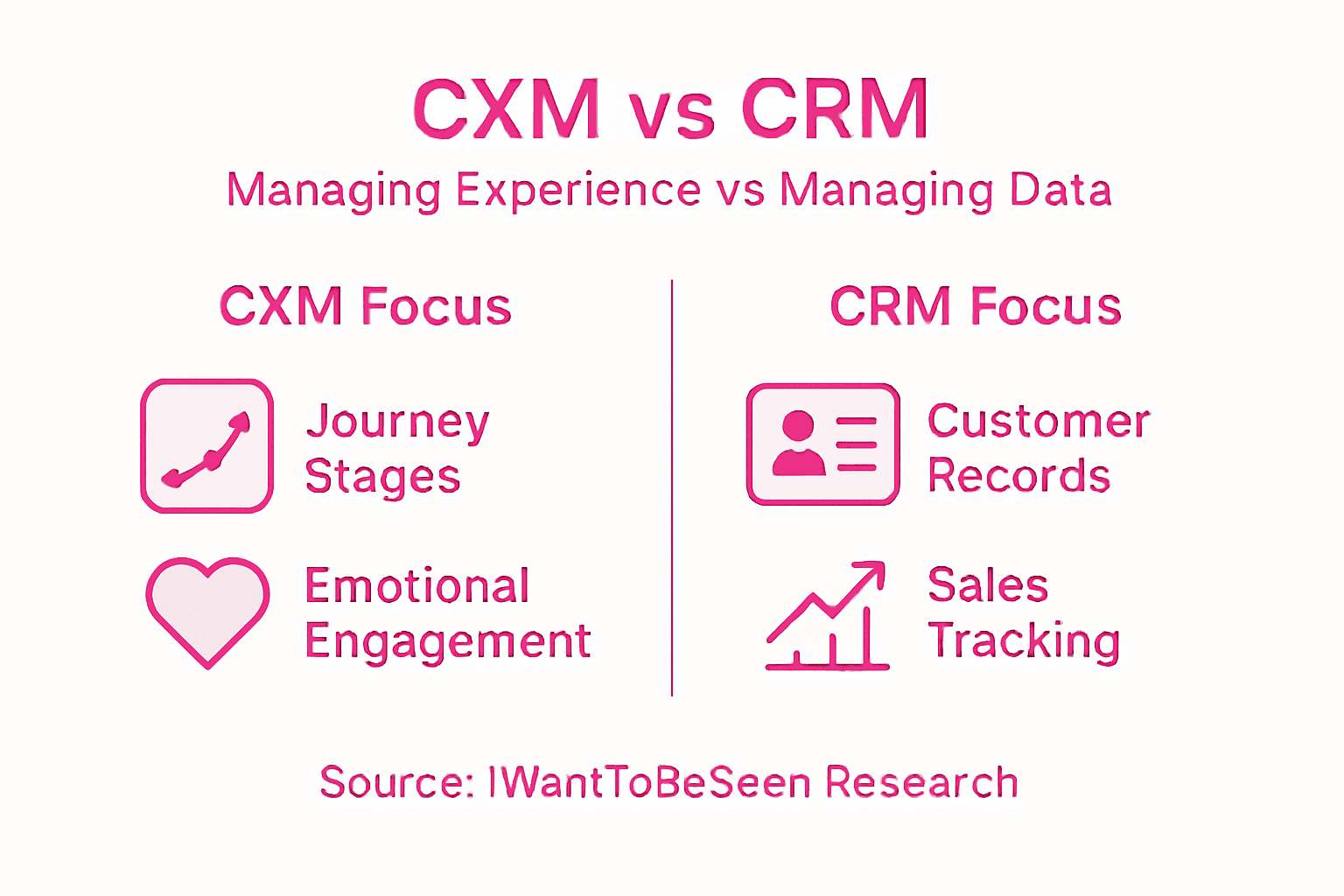
Ecommerce brands must recognise that these approaches are complementary rather than competing. Effective customer strategies integrate both CRM’s data management capabilities and CXM’s experiential design principles to create truly comprehensive customer engagement models.
Pro tip: Integrate your CRM data with CXM insights to develop a 360-degree understanding of your customer experience.
Risks and common mistakes in implementing CXM
Implementing Customer Experience Management (CXM) is fraught with potential pitfalls that can undermine an organisation’s strategic objectives. Implementation risks encompass multiple critical dimensions that demand careful navigation and strategic planning.
Common mistakes organisations frequently encounter include:
Organisational misalignment:
Inadequate cross-departmental communication
Lack of unified customer experience vision
Siloed operational approaches
Technology-related errors:
Overemphasis on technological solutions
Insufficient human-centric design
Complex platforms with poor usability
Strategic implementation failures:
Unclear customer experience strategy
Neglecting continuous experience optimization
Poor measurement and feedback mechanisms
Stakeholder engagement challenges reveal that many organisations struggle to integrate CXM effectively. The most significant obstacles often emerge from insufficient employee training, lack of clear strategic direction, and failure to create robust feedback loops that capture genuine customer sentiment.
Successful CXM implementation requires a holistic approach that balances technological capabilities with human-centric processes. Ecommerce brands must develop comprehensive strategies that address organisational culture, employee empowerment, and continuous learning mechanisms.
Here is a summary of common CXM risks and recommended mitigation approaches:
Risk Area | Typical Mistake | Recommended Mitigation |
Organisational | Siloed departments and poor alignment | Foster cross-team collaboration |
Technological | Overcomplex platforms lacking usability | Prioritise user-friendly tools |
Strategic | No clear customer experience roadmap | Define and update CX strategy |
Feedback and Learning | Inadequate sentiment measurement | Build active feedback loops |
Pro tip: Conduct a thorough organisational readiness assessment before launching your CXM initiative to identify potential implementation barriers.
Best practices for effective digital customer experience
Digital customer experience represents a complex ecosystem of interactions that require strategic, holistic management. Comprehensive digital strategies demand a nuanced approach that integrates technological capabilities with human-centric design principles.
Key best practices for effective digital customer experience include:
Omnichannel integration:
Seamless experiences across digital and physical platforms
Consistent brand messaging
Unified customer interaction points
Personalisation techniques:
Data-driven customer insights
Tailored communication strategies
Adaptive user experiences
Technological enablement:
Advanced analytics capabilities
Real-time interaction tracking
Intelligent customer engagement tools
Digital engagement strategies reveal that successful experiences must address cognitive, emotional, and behavioural dimensions of customer interactions. This means moving beyond transactional approaches to create meaningful, contextually relevant digital experiences that resonate with individual customer needs.
Ecommerce brands must continuously evolve their digital customer experience strategies, recognising that customer expectations are dynamic and technology-driven. Successful implementation requires a commitment to ongoing learning, technological adaptation, and genuine customer-centricity.
Pro tip: Implement regular customer feedback mechanisms to continuously refine and personalise your digital customer experience.
Elevate Your Ecommerce Customer Experience with Expert Digital Marketing
Understanding and managing customer experience is vital to building loyalty in ecommerce. The article highlights common challenges like siloed departments, complex technology, and unclear strategies that can prevent brands from delivering seamless, personalised journeys. If your goal is to reduce friction, strengthen trust, and create emotionally engaging experiences across multiple touchpoints then a specialised approach to digital marketing will make all the difference.
At IWantToBeSeen, we bring over 25 years of expertise scaling successful ecommerce brands through targeted SEO, AI-driven personalisation, social media and PPC campaigns. We focus on using data insights and customer behaviour analysis to craft growth strategies that align perfectly with your customer experience management objectives. Empower your brand with proven digital marketing solutions tailored to meet your exact challenges such as improving satisfaction, building trust, and driving higher retention.

Ready to transform your ecommerce customer journey and drive lasting loyalty? Visit our homepage now and discover how our digital marketing services can seamlessly integrate with your CXM strategy to deliver measurable growth and enhanced customer engagement.
Frequently Asked Questions
What is Customer Experience Management (CXM) in ecommerce?
Customer Experience Management (CXM) refers to a strategic approach that allows ecommerce brands to understand, design, and optimise every interaction customers have with their online platforms, ultimately transforming casual visitors into loyal customers.
What are the key components of an effective CXM strategy?
An effective CXM strategy includes essential components such as satisfaction tracking, trust-building mechanisms, security protocols, service quality standards, and perceived value assessment.
How do CXM platforms differ from CRM systems?
CXM platforms focus on enhancing the entire customer journey and emotional engagement, while CRM systems are primarily data-driven and emphasise improving sales and service efficiency through customer information management.
What common mistakes should businesses avoid when implementing CXM?
Common mistakes include organisational misalignment, overemphasis on technology without a human-centric design, unclear customer experience strategies, and inadequate measurement and feedback mechanisms.
Recommended
Comments