.png)
How to Automate Email Marketing for E-commerce Success


Juggling scattered email campaigns while trying to drive growth can leave even the most seasoned managers frustrated. Defining precise automation goals is the bedrock of transforming your email strategy from random messaging into powerful, targeted communication. With so many platforms, workflows, and integrations available, choosing the right approach matters more than ever for British and Irish e-commerce teams determined to increase conversions and keep customers engaged. This guide sheds light on clear steps to achieve meaningful results through smart email automation.
Table of Contents
Quick Summary
Key Point | Explanation |
1. Define specific automation goals | Establish clear strategic objectives for your email campaigns to enhance targeting and align with business growth. |
2. Choose the right automation platform | Evaluate platforms based on deliverability, integration, and features to match your business needs. |
3. Integrate e-commerce systems effectively | Ensure seamless data flow between platforms for personalised marketing and intelligent customer interactions. |
4. Design targeted automated workflows | Map customer behaviours to communication strategies for tailored messaging that improves engagement. |
5. Regularly test automation performance | Implement A/B testing and analysis to refine email strategies and enhance campaign effectiveness over time. |
Step 1: Define automation goals for your campaigns
Successful email marketing automation begins with establishing precise strategic objectives tailored to your specific e-commerce business. By defining clear goals upfront, you create a roadmap that transforms scattered email campaigns into a powerful, targeted communication strategy.
Starting with marketing automation strategies requires identifying specific key performance indicators (KPIs) relevant to your business. These might include improving click-through rates, increasing conversion percentages, or enhancing customer retention. Different audience segments require nuanced approaches, so developing detailed buyer personas becomes crucial. Your objectives should align closely with broader business growth targets, enabling you to track measurable outcomes systematically.
Begin by categorising your goals into broad strategic aims and narrow tactical objectives. Consider which specific metrics will demonstrate tangible return on investment. Are you seeking to boost revenue, generate more qualified leads, or improve overall customer engagement? Each goal demands a tailored automation approach that speaks directly to your audience’s needs and behaviours.
Expert Advice: Prioritise quality and specificity when setting automation goals rather than generating generic, unfocused targets.
Here is a summary of key automation goals and their likely business impact:
Automation Goal | Example Metric | Business Impact |
Boost sales conversions | Conversion rate increase | Higher revenue from existing customers |
Improve customer loyalty | Repeat purchase frequency | Enhanced customer retention and value |
Grow qualified leads | Number of new subscribers | Larger, more engaged mailing list |
Raise engagement rates | Click-through rate growth | More active and interested audience |
Step 2: Select an email marketing automation platform
Choosing the right email marketing automation platform is a critical decision that can significantly impact your e-commerce success. This step requires careful evaluation of your specific business needs, technical capabilities, and growth potential.

Top email marketing platforms like HubSpot, Mailchimp, and Brevo offer robust automation tools designed to streamline your marketing efforts. When selecting a platform, consider key factors such as deliverability rates, A/B testing capabilities, integration options, and pricing structures. Your chosen platform should provide customisable templates, detailed analytics, and scalability to match your business growth trajectory.
Evaluate each potential platform against your specific requirements. Small businesses might prioritise cost effectiveness, while larger enterprises need advanced segmentation and complex workflow capabilities. Pay close attention to features like customer segmentation, personalisation options, automated trigger emails, and comprehensive reporting tools. Look for platforms that offer seamless integration with your existing e-commerce systems and customer relationship management tools.
Practical Advice: Request free trials from multiple platforms to conduct hands-on testing and ensure the automation software truly meets your specific marketing needs.
The following table compares essential features to consider when choosing email marketing automation platforms:
Feature | Importance for Businesses | Example Benefit |
Deliverability rates | Ensures emails reach inboxes | Maximises campaign effectiveness |
Advanced segmentation | Targets specific customer groups | More relevant communications |
Integration options | Connects with existing systems | Streamlined operations |
A/B testing tools | Optimises campaign components | Improved message performance |
Step 3: Integrate your e-commerce systems seamlessly
Successful email marketing automation depends on creating a unified ecosystem where your various digital platforms communicate effectively. This step involves connecting your email marketing platform with your existing e-commerce infrastructure to enable smooth data flow and intelligent customer interactions.
AI-driven integrated systems now offer sophisticated methods for combining multiple platforms seamlessly. When integrating your systems, focus on ensuring real-time data synchronisation between your e-commerce platform, customer relationship management tools, email marketing software, and analytics dashboards. This interconnectedness allows for more personalised, contextually relevant marketing communications that respond dynamically to customer behaviours and purchase histories.
Look for integration capabilities that support automated workflows such as triggering personalised emails based on specific customer actions abandoned cart events, recent purchases, or browsing patterns. Prioritise platforms offering robust API connections and pre built integrations with popular e-commerce systems. Your goal is creating a fluid marketing ecosystem where customer data moves smoothly between platforms, enabling intelligent automated responses that feel personalised and timely.
Practical Advice: Conduct thorough testing of your system integrations to ensure data accuracy and prevent potential communication breakdowns between different marketing platforms.
Step 4: Design automated workflows and personalised triggers
Automated email marketing workflows transform how e-commerce businesses communicate with customers by creating intelligent, responsive communication systems that adapt to individual customer behaviours and preferences.
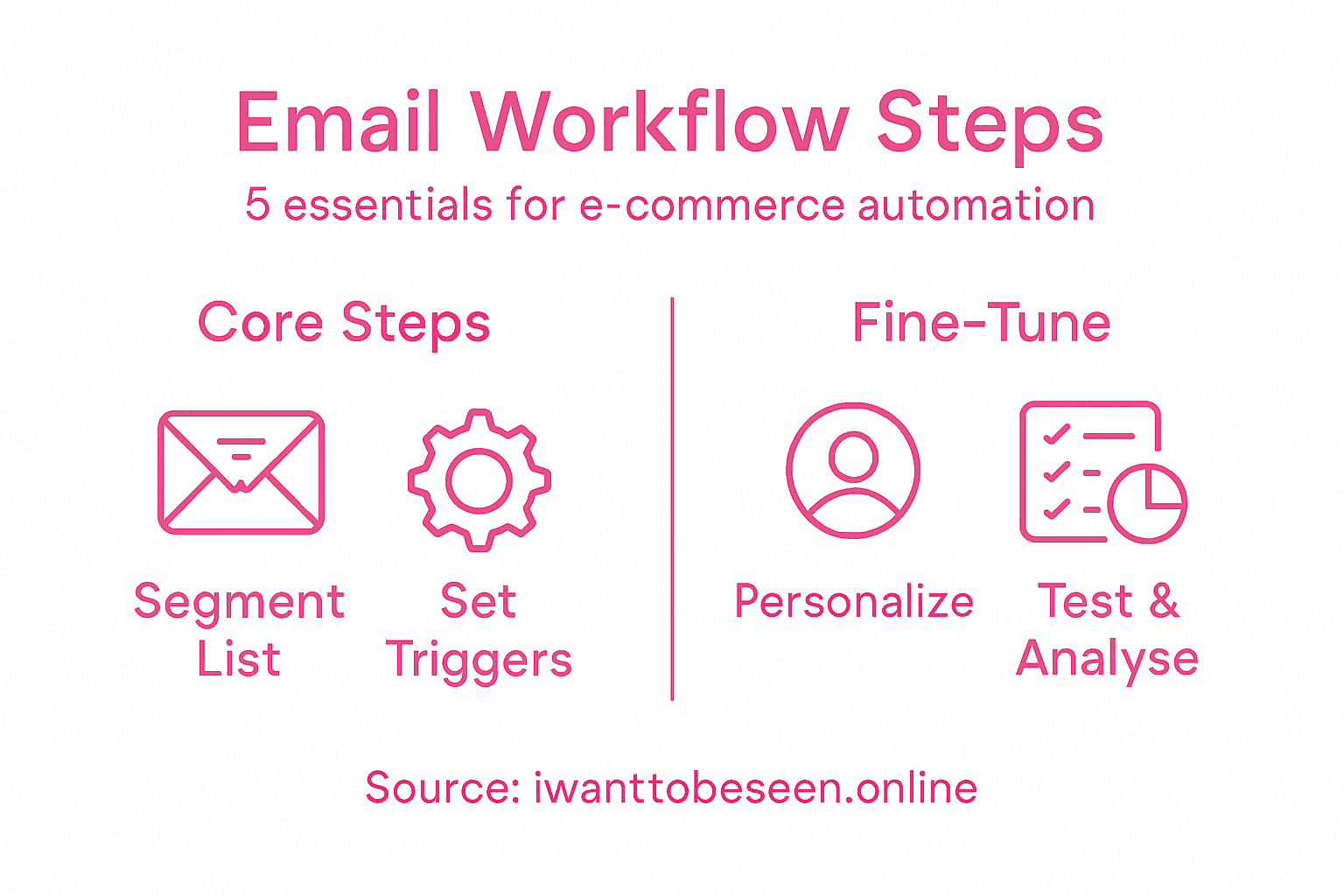
Email automation workflows require strategic design that maps specific customer interactions to targeted communication sequences. Begin by identifying key trigger points in the customer journey such as website registration, product browsing, abandoned cart scenarios, or post purchase moments. Each workflow should include multiple sequential steps that progressively nurture customer engagement through personalised messaging tailored to their specific actions and interests.
Structure your workflows with granular segmentation strategies that enable precise targeting. Consider creating different communication paths for new subscribers, repeat customers, and those showing particular product interests. Implement conditional logic that allows emails to dynamically adjust content based on customer attributes like purchase history, browsing behaviour, or demographic information. This approach ensures your automated emails feel relevant and timely rather than generic and intrusive.
Practical Advice: Test and refine your workflow logic regularly by monitoring performance metrics and customer interaction data to continuously improve your automated communication strategy.
Step 5: Test and verify automation performance
Validating the effectiveness of your email marketing automation requires a systematic approach to measuring and interpreting campaign performance across multiple dimensions of customer engagement.
Experimental testing designs play a critical role in understanding the true impact of your automated workflows. Implement comprehensive A/B and multivariate testing strategies that examine different elements of your email campaigns including subject lines, send times, content variations, and visual design. Focus on measuring key performance indicators such as open rates, click-through rates, conversion percentages, and customer lifetime value to gain meaningful insights into your automation effectiveness.
Establish a robust analytics framework that allows continuous monitoring and iterative improvement of your email marketing strategies. Create benchmarks for performance metrics and set up regular review cycles to identify trends, anomalies, and opportunities for refinement. Pay close attention to segmentation performance, checking how different customer groups respond to various automated communication sequences. This granular approach enables you to make data driven adjustments that progressively enhance the precision and relevance of your marketing automation.
Practical Advice: Document your testing process meticulously and maintain a historical record of performance changes to build institutional knowledge about what truly resonates with your audience.
Unlock E-commerce Growth with Expert Email Marketing Automation Support
The challenge of automating email marketing for e-commerce success lies in defining precise goals, choosing the right platforms, and designing personalised workflows that truly engage customers. If you find yourself overwhelmed by integration complexities or unsure how to turn automation goals into measurable business impact, you are not alone. The key pain points include increasing conversion rates, improving customer loyalty, and creating responsive email workflows that feel personal rather than generic.
At IWantToBeSeen.online, we combine over 25 years of experience scaling e-commerce brands with cutting-edge digital marketing services specialising in SEO, AI, Social Media, and PPC. Our expertise can transform your email marketing automation from a technical challenge into a powerful growth engine. We ensure your systems integrate seamlessly, workflows are finely tuned, and automation goals align with real revenue increases.
Ready to elevate your e-commerce email campaigns now

Discover how our tailored digital marketing solutions can help you boost sales conversions, grow qualified leads, and increase customer loyalty with automation strategies designed for your business. Visit IWantToBeSeen.online today and take the first step towards automated e-commerce success.
Frequently Asked Questions
What are the first steps to automate email marketing for e-commerce success?
To successfully automate email marketing for e-commerce, begin by defining your automation goals. Specify key performance indicators such as improving click-through rates or increasing sales conversions, and create buyer personas to tailor your campaigns effectively.
How can I select the right email marketing automation platform for my e-commerce business?
Choosing the right platform involves evaluating your specific business needs, such as deliverability rates and automation features. Request free trials from multiple platforms to test their functionalities and ensure they meet your unique marketing requirements.
What integration should I focus on for my e-commerce email marketing?
Prioritise seamless integration of your email marketing platform with your e-commerce systems. Look for capabilities that support real-time data synchronisation to enhance personalized communication and trigger automated emails based on customer actions like abandoned carts or recent purchases.
How do I design effective automated email workflows?
To design effective automated workflows, identify key trigger points in the customer journey, such as website registration and product browsing. Structure your workflows with segmented communication paths that adjust content based on customer behaviours and preferences, ensuring emails feel relevant and timely.
How can I test and verify the performance of my email marketing automation?
Test and verify automation performance by implementing A/B testing on various elements of your email campaigns, including subject lines and content variations. Monitor key performance metrics like open rates and click-through rates, and document your results to continually improve your strategy.
Recommended
Comments