.png)
Market Segmentation: Driving eCommerce Success


Most british eCommerce businesses discover that generic marketing fails to connect with their real audience. With marketplace competition on the rise across the United Kingdom and Ireland, understanding customer groups is essential. Remarkably, brands using advanced segmentation see up to 50 percent higher conversion rates than those stuck in one-size-fits-all strategies. You will learn how market segmentation redefines customer targeting and transforms personalised marketing for modern eCommerce success.
Table of Contents
Key Takeaways
Point | Details |
Importance of Market Segmentation | Effective market segmentation allows businesses to understand and target their audience with precision, leading to personalised marketing strategies. |
Types of Segmentation | Businesses should leverage various segmentation types—demographic, behavioural, geographic, and psychographic—to create detailed customer profiles. |
Value of Continuous Refinement | Regularly reviewing and updating customer segments is crucial for adapting to changing behaviours and preferences, ensuring marketing strategies remain effective. |
Integrating Data Analytics | Implementing advanced analytics tools enables real-time insights and the ability to tailor marketing efforts dynamically to evolving customer needs. |
Market Segmentation Defined and Debunked
Market segmentation represents more than just dividing customers into neat categories. It’s a sophisticated strategic approach that enables eCommerce businesses to understand and target their audience with precision. Customer segmentation methods have dramatically evolved from traditional mass marketing techniques towards highly personalised, data-driven strategies.
At its core, market segmentation is the strategic process of grouping potential customers based on shared characteristics, behaviours, and purchasing patterns. Unlike outdated approaches that treat all customers identically, modern segmentation recognises that each customer segment has unique needs, preferences, and potential value. Market segmentation balances the complexity of treating customers as individuals while creating manageable, actionable groups.
Effective market segmentation typically involves multiple dimensions beyond basic demographic data. Sophisticated strategies consider psychographic factors, behavioural patterns, purchasing power, technological engagement, and potential lifetime customer value. This multifaceted approach allows eCommerce businesses to develop targeted marketing strategies, personalise communication, and optimise product offerings for specific customer segments.
Pro tip: Start by conducting comprehensive customer research using analytics tools, surveys, and purchase history data to develop nuanced, accurate market segments that truly reflect your customer base’s diversity.
Major Types of Market Segmentation Explained
Market segmentation encompasses several sophisticated approaches that help businesses understand and target their customers more effectively. Multiple segmentation types provide nuanced insights into customer characteristics, behaviours, and potential purchasing patterns, enabling more precise marketing strategies.

The primary types of market segmentation include demographic, behavioural, geographic, and psychographic categorisations. Demographic segmentation divides customers based on quantifiable characteristics such as age, income, education level, and occupation. Behavioural segmentation focuses on understanding customer interactions, purchase history, brand loyalty, and engagement patterns. Geographic segmentation considers regional differences, including location-specific preferences and cultural nuances. Psychographic segmentation delves deeper, examining customers’ lifestyle choices, values, interests, and personality traits.
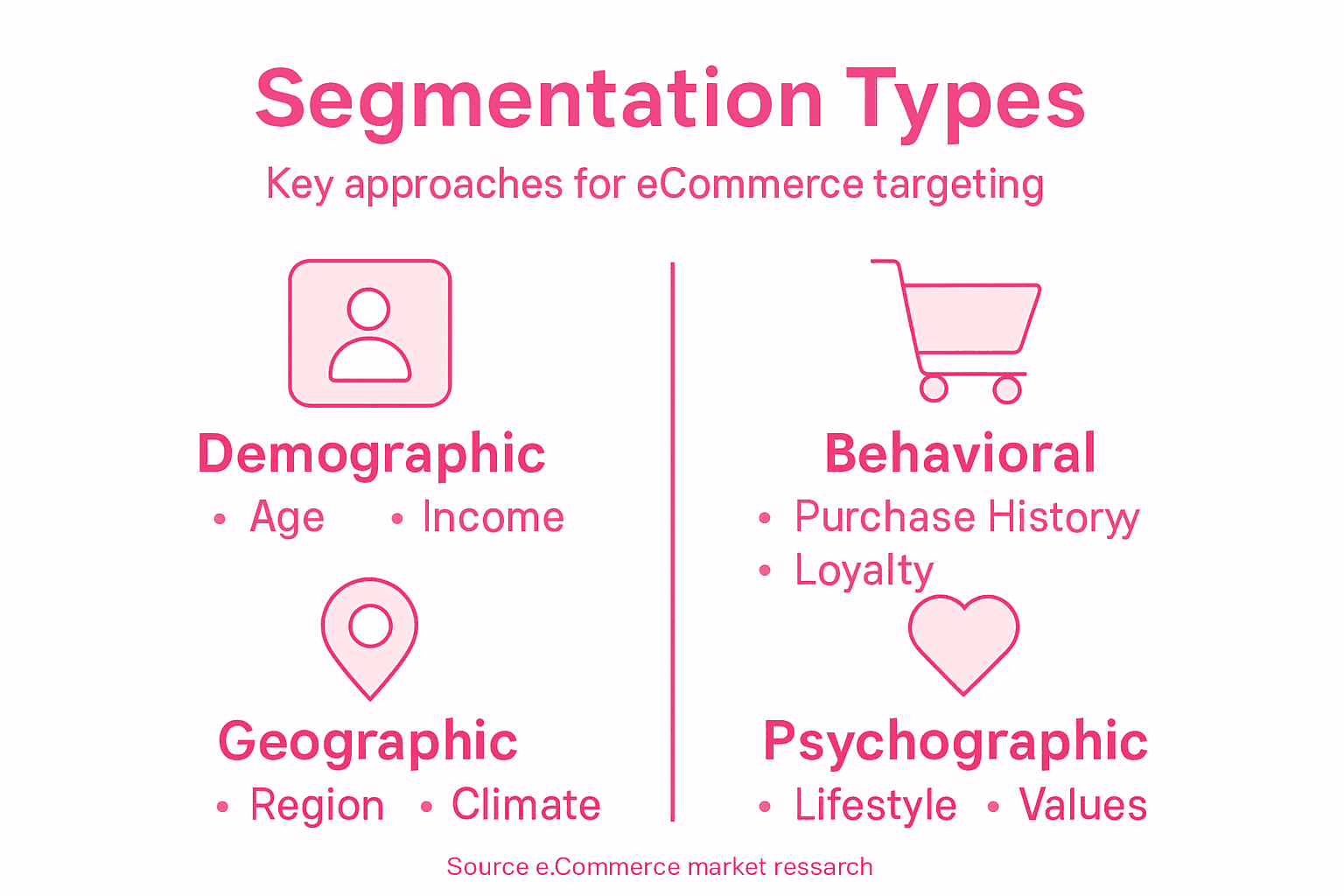
Each segmentation type offers unique strategic advantages for eCommerce businesses. Market segmentation strategies allow companies to develop targeted marketing campaigns, personalise product offerings, and create more meaningful customer experiences. By combining multiple segmentation approaches, businesses can create highly detailed customer profiles that enable precise targeting and improved conversion rates.
Pro tip: Integrate multiple segmentation types to create comprehensive customer profiles, using data analytics tools to uncover deeper insights and develop more nuanced marketing strategies.
Here’s a comparison of the major types of market segmentation and their business impact:
Segmentation Type | Key Focus Area | Typical Data Used | Business Impact |
Demographic | Age, income, education | Census, registration forms | Identify broad customer groups |
Geographic | Location, region | Postcodes, GPS data | Tailor to local preferences |
Behavioural | Shopping behaviour | Purchase history, engagement | Predict buying patterns, boost sales |
Psychographic | Values, lifestyle | Surveys, social data | Craft personalised messages |
How Segmentation Transforms eCommerce Marketing
Personalised marketing strategies have revolutionised the way eCommerce businesses understand and engage with their customers. By leveraging advanced segmentation techniques, companies can move beyond generic marketing approaches and create highly targeted, meaningful interactions that significantly improve customer experience and conversion rates.
Transformation through data occurs when businesses apply sophisticated customer segmentation methods that analyse behavioural patterns, preferences, and purchasing histories. This approach allows eCommerce platforms to craft personalised product recommendations, tailor marketing messages, and develop dynamic pricing strategies that resonate with specific customer groups. The result is a more intuitive, responsive shopping experience that feels custom-designed for each individual customer.
Advanced segmentation goes beyond traditional demographic categorisation by incorporating complex data analysis techniques. Geographic and behavioural segmentation approaches enable businesses to understand nuanced customer needs, predict purchasing behaviours, and create targeted marketing campaigns that speak directly to specific customer segments. By combining multiple segmentation strategies, eCommerce businesses can develop a 360-degree view of their customer base, enabling more precise and effective marketing interventions.
Pro tip: Implement a data analytics platform that integrates multiple segmentation methods, allowing real-time customer insights and dynamic marketing strategy adjustments.
Critical Risks and Common Pitfalls to Avoid
Market segmentation is a powerful strategy, but businesses must navigate carefully to avoid critical segmentation mistakes that can undermine their marketing efforts. These risks range from oversimplification of customer groups to creating segments that are too narrow or too broad to be practically useful.
Confirmation bias represents one of the most significant dangers in market segmentation. Segmentation pitfalls and strategic biases can emerge when businesses unconsciously create segments that confirm their preexisting beliefs rather than reflecting genuine customer characteristics. This approach leads to ineffective marketing strategies that fail to capture the true complexity of customer behaviours and preferences.
Common pitfalls in market segmentation include over-segmentation, neglecting continuous data refinement, and relying too heavily on limited demographic information. eCommerce businesses must develop dynamic segmentation strategies that evolve with changing customer behaviours, technological advancements, and market conditions. Successful segmentation requires a nuanced approach that balances statistical rigour with strategic flexibility, continuously challenging and updating customer segment definitions.
Pro tip: Implement a quarterly review process that critically examines your market segments, using multiple data sources to challenge and validate your existing customer categorisations.
The table below outlines common pitfalls in market segmentation and strategies for mitigation:
Pitfall | Risk for Business | Solution Approach |
Over-segmentation | Unmanageable, small segments | Focus on meaningful group sizes |
Confirmation bias | Biased, ineffective targeting | Regularly validate with new data |
Neglecting ongoing data analysis | Outdated segments, missed trends | Schedule frequent segment reviews |
Relying only on demographics | Superficial understanding of customers | Incorporate behavioural data |
Best Practices for Effective Segmentation Strategies
Developing robust market segmentation requires a strategic approach that goes beyond simple categorisation. Rigorous research methodologies are fundamental to understanding the intricate nuances of customer behaviours and creating meaningful segment definitions that drive marketing effectiveness.
Successful segmentation strategies demand clear, data-driven objectives and continuous refinement. Market segmentation best practices emphasise the importance of setting precise goals, collecting comprehensive customer data, and developing targeted marketing approaches for each distinct customer segment. This approach requires businesses to move beyond superficial demographic classifications and delve into deeper behavioural and psychographic insights that reveal genuine customer motivations and preferences.
Effective segmentation is an ongoing process that demands consistent evaluation and adaptation. eCommerce businesses must develop dynamic segmentation frameworks that can quickly respond to changing market conditions, emerging customer trends, and technological advancements. This requires implementing sophisticated data collection and analysis tools, maintaining a flexible approach to segment definitions, and regularly challenging existing assumptions about customer groups.
Pro tip: Invest in advanced analytics platforms that enable real-time segmentation insights, allowing your marketing strategies to evolve dynamically with changing customer behaviours.
Unlock the Full Potential of Your eCommerce Market Segmentation
The article highlights the critical challenge of transforming raw customer data into meaningful segments that drive personalised marketing success. Many businesses struggle with complex segmentation pitfalls such as confirmation bias and over-segmentation which can limit growth and diminish customer engagement. Understanding behavioural, psychographic and geographic factors is essential but often overwhelming without expert guidance.
At https://iwanttobeseen.online, we specialise in harnessing advanced digital marketing strategies like SEO, AI and tailored PPC campaigns designed specifically for eCommerce brands. With over 25 years of experience scaling dynamic online stores, we help you convert your customer insights into powerful marketing actions that increase conversion and boost lifetime value. Whether you want to refine your segmentation or implement smart data-driven campaigns, our expertise supports your goals.
Leverage proven personalised marketing strategies that cut through the noise and resonate deeply with your audience. Discover how our services integrate data analytics and social media to overcome segmentation challenges and build meaningful connections.
Ready to reshape your marketing trajectory and capture the right customers at the right time?

Explore customised growth solutions at iwanttobeseen.online and transform your market segmentation into tangible eCommerce success today.
Frequently Asked Questions
What is market segmentation in eCommerce?
Market segmentation in eCommerce is the process of dividing potential customers into distinct groups based on shared characteristics, behaviours, and purchasing patterns, allowing businesses to tailor their marketing strategies effectively.
Why is market segmentation important for eCommerce businesses?
Market segmentation is important as it helps eCommerce businesses understand their audience better, enabling them to create personalised marketing campaigns, optimise product offerings, and enhance customer experiences for improved conversion rates.
What are the main types of market segmentation?
The main types of market segmentation include demographic (age, income, education), behavioural (purchase history, engagement), geographic (location-specific preferences), and psychographic (lifestyle, values, interests). Each type provides valuable insights for targeted marketing strategies.
How can businesses avoid common pitfalls in market segmentation?
To avoid common pitfalls in market segmentation, businesses should regularly review their customer segments, validate them with fresh data, and ensure they do not rely solely on superficial demographic information, balancing it with deeper behavioural insights.
Recommended
Comments