.png)
Audience insights for targeted e-commerce growth


TL;DR:
Neglecting audience insights can cost up to 40% in ROAS in e-commerce campaigns.
Combining demographic, behavioral, geodemographic, and RFM data creates effective, actionable segments.
Regular, structured review and integration of AI tools are essential for sustainable growth.
Most e-commerce campaigns are leaving serious money on the table. Neglecting audience insights can cost you up to 40% in ROAS gains that proper targeting would otherwise deliver. Yet the majority of UK and Irish marketing teams still treat audience data as an afterthought, glancing at top-line dashboards before rushing to launch the next campaign. This article changes that. We will walk you through what audience insights genuinely mean for e-commerce, which methodologies actually move the needle, how to apply them to your targeting and creative, and how to build a process that keeps working as your market evolves.
Table of Contents
Key Takeaways
Point | Details |
Actionable data matters | Audience insights go beyond numbers, delivering practical strategies for targeting and content. |
Leverage advanced methods | Combining demographic, behavioural, geodemographic, and AI-driven tools yields deeper results. |
Refined targeting boosts returns | Segmentation and personalised creative powered by insights can increase ROAS significantly. |
Continuous improvement | Audience insights are most valuable when regularly reviewed and adapted for new trends. |
Defining audience insights: More than just data
Audience insights are not simply a collection of numbers sitting in a reporting tab. For e-commerce marketing managers, they represent a structured understanding of who your customers are, how they behave, what they care about, and when they are most likely to convert. That distinction matters enormously when you are responsible for campaign budgets and ROAS targets.
At their core, audience insights reveal demographics, behaviours, interests, and customer characteristics that allow you to build genuinely targeted marketing activity. The raw components typically include:
Demographics: Age, gender, household income, location, and life stage indicators
Behavioural data: Purchase history, browsing patterns, cart abandonment signals, and engagement frequency
Psychographic interests: Category affinities, lifestyle indicators, and content preferences
Contextual signals: Device type, time of day, and channel preference
But gathering these components is only the starting point. What separates actionable insights from data noise is the layer of interpretation placed on top. A dataset telling you that 38% of your buyers are women aged 25 to 34 in Manchester is a demographic fact. An actionable insight is understanding that this cohort responds 60% better to video creative featuring user-generated content, converts primarily on mobile between 7pm and 9pm, and has a significantly higher average order value when shown bundled product offers.
“Actionable insights change what you do next. Pure data just describes what happened.”
This is why behavioural targeting has become a cornerstone of competitive e-commerce strategy. It shifts your thinking from broadcasting to a defined group, towards anticipating the needs of individuals within that group and meeting them at the right moment. That shift is where real conversion gains live.
Key audience insights methodologies in e-commerce
Knowing what audience insights are is one thing. Knowing which tools and methods to use for your specific e-commerce context is another. The good news is that the landscape in 2026 offers more sophisticated options than ever before, and the right combination depends heavily on your business model, customer lifecycle, and data maturity.
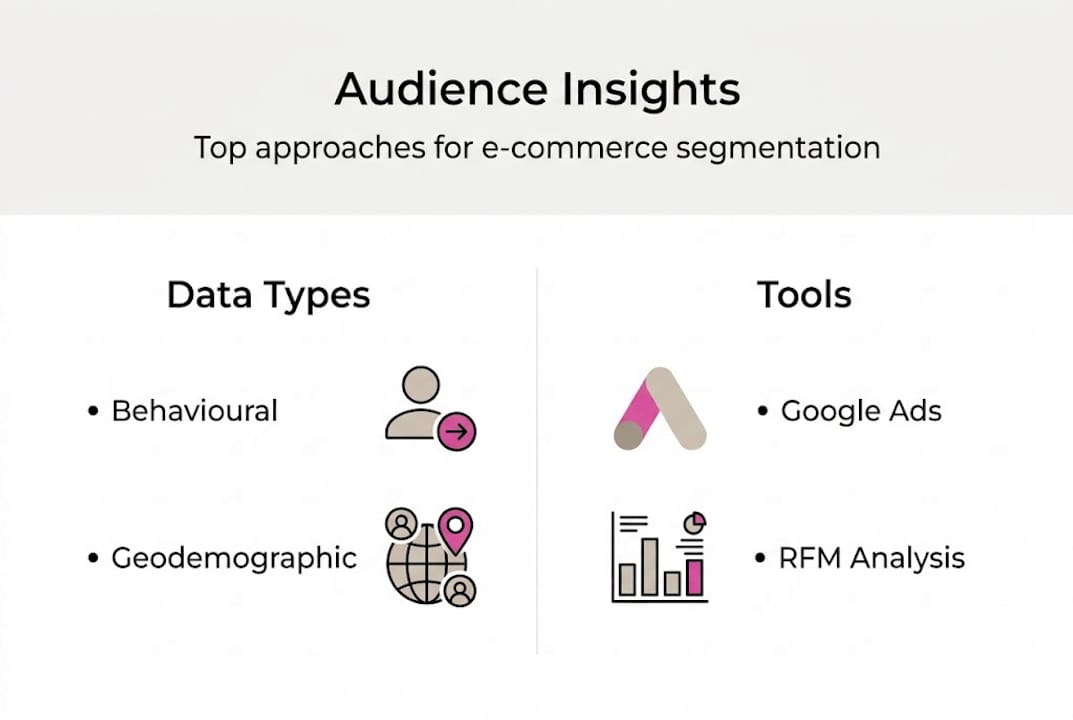
Key methodologies include native platforms such as Google Ads, TikTok, and Facebook, alongside RFM analysis, geodemographic tools like Acorn, and AI-powered aggregation systems. Here is how they compare:
Methodology | Best use case | Strength | Limitation |
Google Ads Insights | Paid search and shopping campaigns | Intent-based, high purchase readiness | Limited to Google ecosystem |
Meta Audience Insights | Social prospecting and retargeting | Rich interest and behavioural data | iOS changes reduced signal accuracy |
TikTok Analytics | Gen Z and millennial brand building | Strong engagement and creative signals | Shorter purchase journey visibility |
RFM Analysis | CRM and email segmentation | Identifies high-value and at-risk customers | Requires clean first-party data |
Acorn Geodemographics | Local and regional UK campaigns | Hyper-local lifestyle and affluence data | Broad brush, less individual precision |
AI-powered platforms | Cross-channel audience aggregation | Real-time, predictive, scalable | Requires investment and data volume |
For UK and Irish e-commerce brands, Acorn geodemographic segmentation is often underutilised. Developed by CACI, it classifies UK postcodes into consumer types based on lifestyle, financial behaviour, and household characteristics. If you are running geo-targeted campaigns across England, Scotland, Wales, or Ireland, layering Acorn data onto your existing segments can sharpen localisation considerably.
RFM analysis (Recency, Frequency, Monetary) remains one of the most reliable frameworks for market segmentation for ecommerce. It scores customers based on how recently they purchased, how often they buy, and how much they spend. Champions and loyal customers identified through RFM should receive very different messaging and offers than customers who have lapsed.

Pro Tip: Do not rely on a single platform for your audience intelligence. Combine native ad platform insights with your CRM data and, where budget allows, a geodemographic overlay. The intersections between those sources are where your most valuable segments hide. AI in marketing tools now make this cross-source aggregation far more accessible than it was even two years ago.
Applying audience insights for targeting and conversion
Gathering insights without a clear application process is one of the most common and costly mistakes in e-commerce marketing. Here is a practical framework for turning what you know about your audience into measurable campaign results.
Audit your existing data sources. Before adding new tools, map what you already have: CRM records, GA4 data, platform analytics, and email engagement reports. Identify gaps and overlaps.
Build your core segments. Use RFM to classify your customer base, then layer in behavioural and demographic signals to enrich each segment profile.
Create tailored creative for each segment. A lapsed high-value customer needs a win-back offer. A new visitor browsing premium products needs social proof. Generic creative loses both.
Build lookalike audiences from your best segments. Uploading your high lifetime value customer list to Google and Meta to generate lookalikes consistently produces strong results. Segmented UK lookalike audiences based on high-LTV customers can improve ROAS by 20 to 40%.
Test, measure, and iterate. Set a 4-week review cadence. Identify which segments are over or under-performing and adjust bids, creative, and targeting parameters accordingly.
Pro Tip: When building email flows, segment email lists by purchase behaviour rather than demographics alone. A customer who bought twice in the last 90 days will respond very differently to a dormant subscriber who purchased once 18 months ago.
For UK-specific campaigns, consider using Acorn classifications to inform both creative tone and channel selection. Acorn’s “Financially Stretched” segments, for example, respond better to value-led messaging and discount-driven CTAs. Meanwhile, “Affluent Achievers” respond to quality cues, exclusivity signals, and editorial-style content. Understanding this nuance is precisely what customer segmentation should enable in practice.
Segment type | Recommended action | Likely channel |
High-LTV active buyers | Upsell and loyalty offers | Email, paid social |
Lapsed high-value | Win-back with incentive | Email, retargeting |
New visitors, high intent | Social proof, reviews | Paid search, display |
Lookalike from top 10% | Prospecting campaigns | Meta, Google, TikTok |
Building a future-ready audience insights strategy
Applying insights well today is valuable. Building a system that continuously improves is what separates brands that sustain growth from those that plateau. Here is what a healthy, ongoing audience insights programme looks like in practice.
AI-powered platforms are transforming the way marketers aggregate and update audience insights for sustainable growth. In 2026, tools like Google’s AI-driven Performance Max and Meta’s Advantage+ already use real-time signals to adjust audience targeting dynamically. The marketers who get ahead are those who learn to guide these systems with strong first-party data inputs rather than letting them run blind.
But technology is only part of the picture. Building a future-ready strategy also means avoiding these common pitfalls:
Overreliance on a single data source. Platform analytics reflect platform behaviour. Your CRM reflects actual purchase behaviour. Neither tells the full story alone.
Analysis paralysis. Collecting data without a structured review process leads to dashboards full of interesting numbers and no action taken.
Set-and-forget segmentation. Customer behaviour shifts, especially post-purchase and across seasonal peaks. Audiences need refreshing, not just monitoring.
Ignoring qualitative inputs. Customer reviews, support queries, and post-purchase surveys reveal motivations that no analytics platform will ever surface automatically.
Neglecting retention-focused insights. Most teams over-index on acquisition data and under-invest in understanding what keeps customers coming back.
A healthy insights programme should include monthly segment reviews, quarterly creative audits based on audience performance data, and at least annual reassessment of which AI in marketing tools are delivering genuine signal versus noise. Build this cadence into your team’s workflow, not as an ad hoc task but as a standing operational process.
Why most e-commerce brands miss the deeper potential of audience insights
After 25 years of building and scaling e-commerce brands, the pattern we see repeatedly is not a lack of data. It is a lack of depth. Most marketing teams look at platform dashboards, see acceptable click-through rates, and call it done. They are optimising the surface while ignoring the structure underneath.
Platform insights often focus on ad performance, while RFM and geodemographics are the real engines for retention and local personalisation. We have seen brands spending heavily on prospecting while their best 15% of customers quietly lapsed. The acquisition team celebrated ROAS. The retention opportunity went unmeasured and unfunded.
The brands that outperform their sectors consistently are the ones that blend sources. They combine platform signals with CRM intelligence, validate findings with qualitative customer feedback, and apply ecommerce market segmentation with genuine precision rather than broad demographic guesswork. The uncomfortable truth is that most audience strategies are built on convenience, not rigour. Changing that requires process, not just better tools.
Bring advanced audience insights to your strategy
If this article has made one thing clear, it is that the gap between brands using audience insights superficially and those using them strategically is widening every quarter. The data is available to almost everyone. What is rare is knowing exactly how to combine, interpret, and act on it at scale.

At iwanttobeseen.online, we have spent over 25 years doing precisely that for our own brands and our clients. From RFM-led segmentation to AI-powered cross-channel audience building, we bring the experience and technical capability to make your audience insights strategy work harder. If you are ready to move beyond dashboard-gazing, explore expert e-commerce guidance tailored to your specific growth stage and market.
Frequently asked questions
What are the most important types of audience insights for UK and Ireland e-commerce?
Demographic, behavioural, geodemographic (such as Acorn for UK retail), and RFM-based insights are the four pillars that enable effective targeting and sustained conversion improvement.
How do audience insights improve conversion rates?
They enable precise segmentation and personalised creative, with lookalike and RFM segmentation consistently delivering ROAS improvements of 20 to 40% for UK e-commerce campaigns.
Is AI essential for building a modern audience insights strategy?
AI-powered platforms have become critical for aggregating, refining, and dynamically updating audiences at the speed and scale that today’s competitive market demands.
How often should audience insights be updated?
Monthly reviews with ongoing adjustments are the baseline, as ongoing audience analysis is essential for sustaining targeting accuracy and avoiding audience fatigue.
Recommended
Comments