.png)
How to Use Social Proof to Boost Ecommerce Sales


Choosing between similar products or committing to a purchase, many online shoppers feel a moment of hesitation that can stall sales and erode trust. For Ecommerce leaders in the United Kingdom and Ireland, recognising these touchpoints is crucial as competition rises and customer expectations shift. By identifying where social proof opportunities exist during the buyer journey, you set the groundwork for higher conversion rates and stronger credibility. This approach lets you address uncertainty at exactly the right moment, transforming doubt into confident buying decisions.
Table of Contents
Quick Summary
Key Point | Explanation |
1. Identify key moments of doubt | Map out critical touchpoints during the buying journey where customers hesitate, allowing for targeted social proof integration. |
2. Use specific, impactful testimonials | Collect detailed testimonials that highlight real transformation and quantifiable benefits to enhance credibility. |
3. Strategically place social proof | Distribute social proof across the website, particularly on product and checkout pages, to build trust effectively. |
4. Optimise locations for social proof | Conduct A/B testing to find the best placements for social proof, ensuring it aligns with customer decision-making moments. |
5. Continuously monitor and refine strategy | Track performance metrics to assess the impact of social proof and adapt strategies for continuous improvement based on data. |
Step 1: Identify key social proof opportunities
You need to map out where your customers experience doubt during their buying journey. These moments of hesitation are your goldmines for social proof. Whether someone is browsing your product pages, reading descriptions, or sitting on the checkout screen, each step presents a distinct opportunity to build trust and reduce friction.
Start by examining your customer journey from the top of the funnel right through to post-purchase. Where do visitors abandon their carts? Where do they spend the most time second-guessing themselves? Research shows that online reviews and user-generated content significantly influence purchase decisions at multiple touchpoints. The key is identifying those specific moments when your potential customers are most vulnerable to doubt.
Consider the types of social proof that align with your audience’s concerns. Customer testimonials work brilliantly on product pages where people are comparing options. Case studies and expert endorsements resonate when you’re selling high-ticket items that require more deliberation. Meanwhile, customer reviews, influencer endorsements, and user-generated content prove especially powerful for niche retailers establishing credibility in emerging markets.
Audit your current touchpoints systematically. Take screenshots of your product pages, landing pages, checkout flow, and email sequences. Mark down where trust signals currently exist and where notable gaps appear. A product with zero reviews sends a different message than one surrounded by five-star ratings. Similarly, checkout pages without security badges or payment guarantees will trigger more abandonment than pages where these reassurances are visible.
Don’t overlook post-purchase moments either. Confirmation emails, delivery tracking pages, and follow-up communications give you chances to reinforce confidence in their purchase decision. These interactions build loyalty and encourage repeat business, which matters enormously for sustainable growth.
Here is a summary of common types of social proof and their best placement on e-commerce sites:
Social Proof Type | Best Placement | Primary Benefit |
Customer Testimonials | Product Pages | Build trust and highlight value |
Expert Endorsements | Homepage, Landing Pages | Provide authority and credibility |
User-Generated Content | Gallery, Product Pages | Show authentic customer usage |
Trust Badges | Checkout Pages | Reinforce security and reassurance |
Case Studies | High-Ticket Product Pages | Support complex purchase decisions |
Real-Time Purchase Alerts | Checkout, Banner Areas | Create urgency and reduce hesitation |
Professional tip Visit your competitors’ product pages and note exactly where they position reviews, testimonials, and trust badges—then do it better by adding additional proof types they’re missing.
Step 2: Collect and curate impactful testimonials
You cannot build social proof with vague praise. Generic compliments like “great product” or “fantastic service” blend into background noise. Instead, you need testimonials that tell a story about real transformation or specific value your customers received.
Start by reaching out to satisfied customers whilst their experience is fresh. Timely requests avoid loss of contact and fading memories, which means the best moment to ask is within days of a successful purchase or positive interaction. Send a thoughtful email explaining why their feedback matters. Make the process easy by asking specific, probing questions rather than leaving it open-ended.
Ask your customers to describe exactly what problem your product solved for them. What was their situation before? What changed after using your offering? How does it impact their daily operations or bottom line? Rich, specific narratives that detail actual impact prove far more credible than generalised praise. Numbers work brilliantly here too. If a customer saved time, ask them to quantify it. If they increased revenue, request the percentage. A testimonial stating “saved me 5 hours per week” outperforms “saved me lots of time” by a considerable margin.
Include identifying details in every testimonial you publish. The customer’s name, job title, and company name all matter tremendously. Someone is far more likely to trust feedback from “Sarah Mitchell, Operations Manager at Bright Foods Ltd” than from “a satisfied customer.” This transparency transforms anonymous praise into genuine credibility.
Once collected, edit testimonials for clarity and brevity whilst preserving the customer’s voice. Remove jargon, tighten wordy passages, and ensure the core benefit shines through. You are curating a collection that speaks to different buyer concerns, so select testimonials that represent various use cases and customer types.
Professional tip Record video testimonials from your best customers, as moving footage dramatically outperforms text and creates authentic social proof that static reviews cannot match.
Step 3: Implement social proof across your website
Placing social proof in the right locations transforms passive site visitors into confident buyers. Your job is to strategically distribute trust signals throughout the customer journey, not just concentrate them in one spot.
Start with product pages, your highest-value real estate. Display customer reviews prominently alongside star ratings, review counts, and verified purchaser badges to give shoppers concrete evidence of quality before they commit. Position reviews above the fold if possible, so visitors encounter them without scrolling. Include a mix of short snippets and longer detailed reviews, allowing different readers to find the information they need.

Extend social proof beyond product pages to your entire site. Landing pages benefit enormously from testimonials that speak to specific pain points. Your homepage should feature customer success stories that demonstrate real outcomes. Checkout pages require reassurance, so add trust badges from payment providers, security certifications, and perhaps a recent purchase notification showing other customers completing transactions successfully.
Real-time purchase notifications and testimonials build trust by reflecting actual customer behaviour, helping overcome last-minute doubts at the critical moment when visitors decide whether to complete their purchase. Seeing “Sarah from Manchester just ordered this product” or “James verified this review after purchase” creates urgency and authenticity that static content cannot match.
Incorporate expert endorsements and user-generated content from your social media channels. If industry influencers or publications have endorsed your products, display those logos prominently. Instagram feed integrations showing customer photos using your products add authenticity and variety to your site’s visual landscape.
Test different placements and formats to discover what converts best for your specific audience. What works brilliantly on one product category might underperform on another. Monitor engagement and conversion metrics to refine your approach continuously.
Professional tip Place a rotating testimonial carousel on your homepage footer so returning visitors see different customer stories, maintaining freshness and preventing them from tuning out familiar static content.
Step 4: Optimise placements for maximum influence
Not all placements deliver equal results. The location of your social proof signals dramatically affects their persuasive power. Your goal is to match each type of proof to the exact moment when customers need reassurance most.
Identify where your customers experience the highest uncertainty. On product pages, this happens when shoppers compare options or read detailed descriptions. During checkout, doubt peaks at the payment screen when real money is at stake. On category pages, indecision occurs when choosing between multiple similar products. Strategic placement of social proof at these high-friction moments in the customer journey reduces uncertainty and motivates action. Place testimonials and reviews exactly where visitors need them, not where you think they look best aesthetically.
Test different positions systematically. Use A/B testing to refine where social proof has the strongest persuasive effect and highest conversion uplift rather than guessing. Try reviews above the fold on some product pages and below the fold on others. Move testimonials from the sidebar to the main content area and measure the impact. Track which variations produce higher conversion rates, longer time on page, and lower bounce rates.
Avoid cluttering your pages with excessive social proof. More is not always better. Too many review widgets, testimonial blocks, and trust badges can overwhelm visitors and trigger scepticism. They may question whether you are trying too hard to convince them, which backfires spectacularly. Balance is critical. One strong testimonial positioned strategically outperforms three mediocre ones scattered randomly across the page.
Consider context and relevance when placing proof elements. Feature reviews from customers in similar industries on your B2B product pages. On lifestyle products, showcase user-generated content from aspirational customers. Match the social proof type to the specific concern your target audience has at that moment.
Monitor your analytics continuously. Which pages have the highest conversion rates when social proof is visible? Where do visitors spend the most time engaging with testimonials or reviews? Use this data to guide your optimisation decisions.
Professional tip Place your highest-rated review or most compelling testimonial in the first position, as most visitors see this before scrolling, making it your single most important social proof placement decision.
Step 5: Monitor performance and refine your strategy
Social proof is not a set-and-forget tactic. Your strategy must evolve based on real performance data collected from your site. Without measurement and iteration, you’re essentially flying blind whilst your competitors optimise their approach.
Start by identifying the key performance indicators that matter most to your business. Conversion rate stands as your primary metric, showing whether social proof actually drives sales. Track this alongside checkout abandonment rate, which reveals whether reviews and testimonials address customer hesitation at the critical moment. Monitor engagement metrics like how long visitors spend viewing reviews, how many click to expand testimonials, and whether they interact with user-generated content. These behaviours indicate whether your social proof resonates with your audience.
Ongoing analysis of social proof’s impact on conversion rates and trust metrics, combined with adaptation of testimonial collection and optimisation of content mix, is vital for sustained ecommerce growth. This means segmenting your audience to understand which types of social proof work best for different customer groups. Your premium buyers might respond better to expert endorsements whilst budget-conscious shoppers prefer peer reviews. Different product categories will perform better with different proof types too.
Using KPIs such as conversion rate, response rate to review requests, and engagement with user-generated content to iterate on tactics like timing of review requests ensures continuous improvement. Test variations systematically. Adjust when you ask customers for reviews. Personalise which social proof elements appear to which visitor segments. Change the order of testimonials based on which ones generate the highest engagement.
Schedule monthly reviews of your performance data. Look for patterns. Which products generate the most reviews? Which pages show the highest conversion uplift when social proof is visible? Which customer segments engage most with testimonials? Use these insights to double down on what works and eliminate what does not.
To help you review success, here is a comparison of key performance indicators (KPIs) for tracking social proof effectiveness:
KPI | What It Measures | Why It Matters |
Conversion Rate | Percentage of visitors who buy | Indicates if proof boosts purchases |
Checkout Abandonment Rate | How often carts are abandoned | Reveals hesitation at purchase stage |
Review Request Response Rate | Customer willingness to give feedback | Shows effectiveness of testimonial outreach |
Engagement with Social Proof | Time spent or clicks on reviews | Demonstrates actual impact on trust |
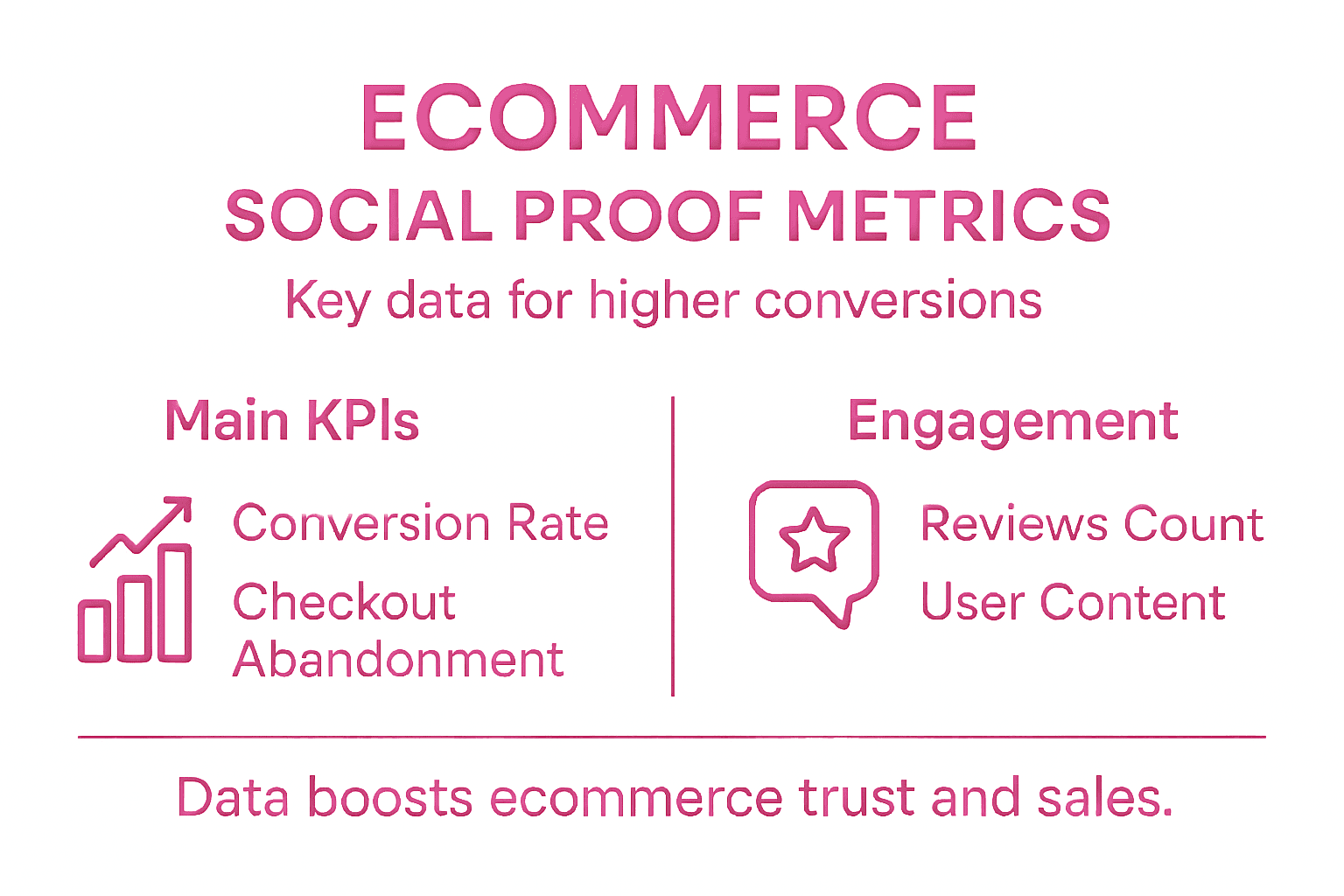
Professional tip Create a spreadsheet tracking conversion rate, checkout abandonment rate, and review request response rate by month so you can visualise trends and spot exactly when your optimisations produce measurable improvements.
Harness the Power of Social Proof to Elevate Your Ecommerce Success
Understanding the challenge of converting hesitant visitors into loyal customers is key. The article highlights crucial pain points such as customer doubt during the buying journey, optimising testimonial placement, and strategically using trust signals like customer reviews and expert endorsements. These are exactly the hurdles that can stall your ecommerce growth without a solid digital marketing strategy that leverages these social proof tactics effectively.
At IWantToBeSeen.online, we combine over 25 years of experience helping ecommerce brands flourish through targeted SEO, AI-powered insights, and social media marketing that maximises your proof points. Our expert team knows how to collect compelling testimonials, position trust badges, and activate real-time purchase alerts that build confidence at every step. Let us guide you in transforming these social proof strategies into increased conversion rates and reduced cart abandonment.
Boost your ecommerce impact with tailored digital marketing solutions designed to highlight your brand’s credibility. Discover how we can help by visiting our landing page and start turning visitor doubt into decisive action today.

Don’t let uncertainty hold your customers back any longer. Partner with IWantToBeSeen.online now for expert support in embedding powerful social proof throughout your site to drive sales and foster lasting customer trust.
Frequently Asked Questions
How can I identify moments of doubt in my customer’s journey?
To identify moments of doubt, map out your customer’s journey from initial interest to post-purchase. Look for points where visitors abandon their carts or hesitate on product pages, and evaluate their experience to pinpoint opportunities for adding social proof.
What types of social proof are most effective for e-commerce sites?
Effective types of social proof include customer testimonials on product pages, expert endorsements on landing pages, and user-generated content in galleries. Implement a mix of these to address various customer concerns and enhance their confidence in your offerings.
How should I collect testimonials from my customers?
Collect testimonials by reaching out to satisfied customers shortly after their purchase. Ask specific questions about the problems your product solved and encourage them to share detailed and quantifiable experiences.
Where should I place social proof on my website for maximum impact?
Place social proof strategically on product pages, prominently displaying reviews and ratings above the fold. Also, include testimonials on landing and checkout pages, ensuring they are visible during critical decision-making moments for customers.
How can I monitor the performance of my social proof elements?
Monitor the performance by tracking key metrics such as conversion rates and checkout abandonment rates. Regularly analyse this data to identify what types of social proof are most effective, then refine your strategy accordingly to boost sales.
What should I do if my social proof isn’t increasing sales?
If social proof isn’t increasing sales, revisit its placement and ensure it aligns with moments of customer hesitation. Consider varying the types of proof and testing different formats to find what resonates best with your audience.
Recommended
Comments