.png)
Retargeting pixels: boost e-commerce ROI by 10x


TL;DR:
Most UK and Ireland e-commerce businesses overlook retargeting pixels, missing significant revenue opportunities.
Proper implementation requires explicit user consent and compliance with GDPR and PECR regulations, often via a consent management platform.
Continuous testing, segmentation, and creative optimization are essential for maximizing retargeting effectiveness and avoiding compliance pitfalls.
Most e-commerce businesses in the UK and Ireland are sitting on a goldmine they’ve never touched. Retargeting pixels are routinely dismissed as tools for enterprise brands with six-figure ad budgets, yet the reality is quite the opposite. Up to 97% of your site visitors leave without buying anything on their first visit. A correctly implemented pixel gives you a structured, measurable way to bring those shoppers back. The catch, especially for UK and Ireland businesses, is that the regulatory landscape makes careless implementation a costly mistake. This guide demystifies what retargeting pixels are, how they work, and how to deploy them compliantly and profitably.
Table of Contents
Key Takeaways
Point | Details |
Retargeting pixels explained | A retargeting pixel tracks site visitors to enable personalised ad campaigns for those who didn’t buy. |
Strict compliance mandatory | UK and Ireland law demands explicit visitor consent before any pixel is activated for marketing. |
Business impact is dramatic | Done right, retargeting pixels can recover vast numbers of lost sales and multiply e-commerce ROI. |
Common pitfalls to avoid | Major mistakes include firing pixels before consent and sending generic messages that lower returns. |
Practical action steps | Segment audiences, update consent flows, and use consent-gated solutions for best results. |
What is a retargeting pixel and how does it work?
A retargeting pixel is a small snippet of JavaScript code that you place on your website. When a visitor lands on a page, the pixel fires and drops an anonymous cookie in their browser. That cookie then allows advertising platforms such as Facebook, Google, and TikTok to identify that specific user as they browse other websites and serve them tailored ads related to what they viewed on your site.

Think of it like a polite tap on the shoulder. Someone browses your running shoes, leaves without buying, and then sees your ad while reading a news article later that afternoon. The pixel made that possible.
Here is how the core process works in practice:
Tracking: The pixel records which pages a visitor views, how long they spend, and what actions they take such as adding to cart or reaching checkout.
Triggering: When that visitor appears on a partner platform, the pixel data matches them to your audience list.
Ad personalisation: The platform delivers a relevant ad, often featuring the exact product the visitor browsed.
Conversion reporting: The pixel also records when a user completes a purchase, allowing you to measure return on ad spend accurately.
Modern pixels from Meta (Facebook), Google, and other networks integrate directly with e-commerce platforms like Shopify and WooCommerce, making setup more accessible than ever. However, there is one critical point that many UK and Ireland businesses get wrong from the start.
“Retargeting pixels require explicit prior consent before firing in the UK and Ireland,” as set out in the ICO’s guidance on storage technologies. This means your pixel must not activate until a visitor has actively accepted your cookie policy.
This is where a consent management platform (CMP) becomes essential. A CMP sits between your site and your pixel, ensuring the tracking code only fires once a user has clicked “accept” on your cookie banner. Popular options include OneTrust, Cookiebot, and CookieYes. Without one, you are likely in breach of PECR (Privacy and Electronic Communications Regulations) from the moment a visitor lands on your site. Understanding retargeting ROI basics is important, but it starts with getting the technical foundation right.
Pixel component | What it does |
JavaScript snippet | Fires on page load to collect session data |
Browser cookie | Stores anonymised visitor identifier |
Audience list | Groups visitors by behaviour for targeting |
Ad platform match | Identifies the user on third-party sites |
Conversion event | Reports purchases back to the platform |
Why are retargeting pixels crucial for e-commerce success?
Now that you understand what a pixel does, it is important to see why it is vital for e-commerce growth and profitability.
The core problem every online shop faces is that the vast majority of visitors do not convert on their first visit. They are browsing, comparing, or simply not ready yet. Without a pixel, those visitors are gone permanently. With one, they become a warm audience you can re-engage at a fraction of the cost of cold advertising.
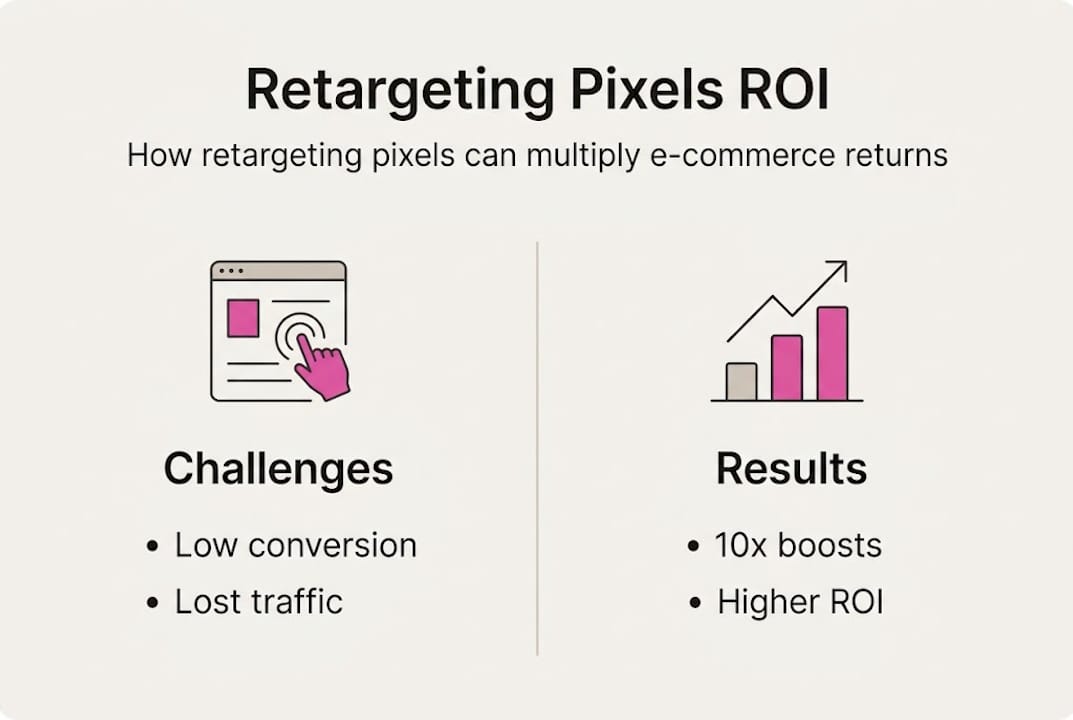
Retargeted ads can boost conversion rates by up to 10x compared to standard display advertising. That is not a marginal improvement. It fundamentally changes the economics of your paid media spend.
Here is a straightforward look at what separates businesses using pixels from those that are not:
Factor | With retargeting pixel | Without retargeting pixel |
Visitor recovery rate | Up to 26% of lost visitors re-engaged | Near zero recovery |
Ad spend efficiency | Higher ROAS from warm audiences | Lower ROAS from cold targeting only |
Customer journey | Multi-touch, personalised experience | Single-touch, generic messaging |
Average conversion cost | Significantly lower | Higher due to cold traffic |
Data collected | Rich behavioural data | Minimal insight |
Here is how a pixel supports the customer journey step by step:
Awareness visit: User finds your site via organic search or social media.
Pixel fires (with consent): Behavioural data is recorded and user is added to your audience.
Off-site engagement: User sees personalised ads on Facebook, Instagram, or Google Display.
Return visit: User revisits your site, often more purchase-ready.
Conversion: User completes a purchase, closing the loop and feeding data back into your pixel.
Upsell opportunity: Post-purchase pixel events enable you to segment and target for repeat orders.
Statistic callout: Businesses that run retargeted campaigns alongside their primary paid media see an average increase of 147% in conversion rates compared to those running standard campaigns alone.
It is also worth noting that retargeting pixel ROI improves substantially when you layer audience segmentation on top, targeting cart abandoners differently from product browsers, for instance. Critically, firing pixels before user consent is a violation that can lead to fines of up to 4% of global revenue, which makes proper implementation non-negotiable.
Regulatory compliance: Navigating pixel setup in the UK and Ireland
While the performance upside is clear, mismanaging compliance can expose you to major risk, so here is how to get pixel deployment right under UK and Ireland law.
GDPR and PECR together create a specific set of obligations for anyone placing tracking technologies on a UK or Ireland website. The rules are not complicated in principle, but they are frequently ignored or misunderstood by e-commerce operators.
Key compliance requirements include:
Explicit, unticked consent: Your cookie banner must require an active opt-in. Pre-ticked boxes are not lawful. The user must make a deliberate choice to allow tracking pixels.
Consent before firing: The pixel must be blocked until the user has accepted. No exceptions. Firing on page load before consent is a direct violation.
Consent management platform: A CMP is the practical tool that enforces this. It gates the pixel code and logs consent records for audit purposes.
Granular consent options: Users should be able to accept analytics cookies without accepting marketing pixels. Bundled consent is generally not sufficient.
Data transfer compliance: If your pixel sends data to a US-based platform such as Meta or Google, you need Standard Contractual Clauses (SCCs) or to rely on the Data Privacy Framework (DPF). This is an often-overlooked area.
Regular audits: Consent flows need periodic review as platforms update their code and as your site changes.
As the ICO makes clear, pixels require explicit prior consent, must be blocked until accepted via CMP, and any firing before consent constitutes a violation. For US data transfers, SCCs or DPF compliance is required, and fines can reach 4% of global revenue.
Pro Tip: Work with developers who have specific experience in consent-gating, server-side tagging, and Facebook’s Conversions API (CAPI). Server-side tagging moves data collection from the browser to your server, reducing the risk of browser-based consent failures and giving you more control over what data leaves your environment.
For a practical walkthrough, our remarketing setup guide covers the technical steps in detail, and our Facebook ads setup tips address CAPI integration specifically for Meta campaigns.
Best practices and pitfalls: Maximising returns from retargeting pixels
Equipped with both the value proposition and regulatory knowledge, let us focus on actionable ways to get more from your retargeting pixels without running afoul of the rules.
The difference between a retargeting campaign that frustrates users and one that drives real revenue usually comes down to segmentation and creative discipline. Generic retargeting, where every visitor sees the same ad regardless of where they dropped off, is one of the most common and costly mistakes in e-commerce advertising.
Audience segmentation strategies that work:
Cart abandoners: High-intent users who got close. Target with urgency-led messaging or a limited-time offer.
Product page viewers: Warm but earlier in the journey. Use social proof, reviews, or comparison content.
Previous customers: Target with complementary products or loyalty incentives rather than repeating the original pitch.
Checkout drop-offs: Show frictionless payment options or address common objections like shipping costs.
Improving ad relevance is directly tied to how precisely you segment. Broad audiences produce mediocre results. Tight, behaviour-based segments produce excellent ones.
Pro Tip: A/B test your creatives and landing pages specifically for retargeted users. These visitors already know your brand, so leading with brand awareness content is wasted effort. Test direct response messaging, product-specific imagery, and personalised offers instead.
Common pitfalls to avoid:
Generic messaging served to all visitors regardless of their behaviour
Pixel firing before user consent has been captured
Outdated pixel integrations that no longer pass the correct events
Failing to exclude converted customers from acquisition-focused retargeting
Not using frequency caps, which leads to ad fatigue and negative brand associations
Using behavioural targeting for loyalty programmes alongside retargeting pixels creates a compounding effect, turning one-time buyers into repeat customers systematically. As the ICO guidance confirms, best practice means using consent-gated pixels and leveraging CAPI with appropriate filters for full GDPR and PECR compliance.
The hard truth: Why most e-commerce businesses fail with pixels
Now, let us reflect on where most brands go wrong and what actually sets winners apart in the retargeting game.
After working with e-commerce businesses across the UK and Ireland for over two decades, we have noticed a consistent pattern. The brands that struggle with retargeting are not usually failing because of technical errors. They are failing because they treat pixel implementation as a one-time task rather than an ongoing practice.
Compliant pixels with poor creative strategy produce poor results. Full stop. We have seen businesses invest in proper CMP setup, build beautifully consent-compliant campaigns, and then run the same static banner ad to every retargeted visitor for six months. The result is wasted budget and frustrated shoppers.
The brands that win understand why a visitor left in the first place. They treat that exit as data. They test messaging, adjust frequency, update offers seasonally, and segment relentlessly. Success with remarketing for repeat sales is less about technology and more about the discipline of continuous improvement.
Treat compliance and creative testing as daily hygiene, not annual checkboxes. The technology is accessible. The mindset is what separates the brands that scale from those that stagnate.
Elevate your e-commerce campaigns with expert support
If you want your next campaign to stand out while staying compliant, here is your best next step.
We have spent over 25 years building and scaling e-commerce brands across the UK and Ireland. Retargeting pixel strategy, consent compliance, and campaign performance are areas we live and breathe daily. Whether you need a full retargeting pixel solutions audit, help implementing CAPI alongside your consent management setup, or a complete overhaul of your remarketing audiences, we have the technical and strategic expertise to deliver it.

Our team understands the specific pressures of GDPR and PECR compliance without sacrificing performance. We combine deep Facebook ad expertise with a proven track record of measurable results for UK and Ireland e-commerce businesses. Get in touch today and let us build a retargeting strategy that converts and complies.
Frequently asked questions
Are retargeting pixels legal in the UK and Ireland?
Yes, but you must obtain explicit visitor consent before the pixel fires. As ICO guidance confirms, pixels require unticked, active opt-in and must be blocked via a CMP until accepted.
How can I check if my pixel is compliant?
Use a consent management platform to ensure the pixel only activates after user approval, and audit your setup regularly. Pixels that fire before consent constitute a direct PECR violation.
What are the penalties for non-compliant pixel use?
Penalties are substantial. Fines up to 4% of global annual turnover can be issued for serious GDPR and PECR consent breaches involving tracking technologies.
Is server-side tracking like Facebook CAPI necessary?
It is highly recommended, particularly in privacy-focused markets like the UK and Ireland. Consent-gated pixels plus CAPI with appropriate filters offer the most robust compliance and data quality combination available.
Recommended
Comments