.png)
Ecommerce Analytics Explained: Complete Guide for 2025

Updated: Jan 23

Over 80 percent of online businesses struggle to turn raw data into meaningful action. The flood of digital information can leave even the savviest retailers guessing about what actually drives growth. Ecommerce analytics offers a way out of the chaos by breaking down complex numbers into real insights, helping brands understand their audience, improve strategy, and outpace competitors in a crowded marketplace.
Table of Contents
Key Takeaways
Point | Details |
Ecommerce Analytics Definition | Ecommerce analytics is essential for decoding customer behavior and market trends, enabling data-driven business decisions. |
Types of Analytics Tools | Key tools include web traffic analytics, conversion rate tools, and revenue performance platforms that provide insights into various performance metrics. |
Critical Metrics | Important metrics such as conversion rate, customer acquisition cost, and cart abandonment rate are vital for evaluating online retail success. |
Best Practices for Implementation | Effective ecommerce analytics requires clear objectives, appropriate tool selection, and regular data review processes to drive meaningful insights. |
Defining Ecommerce Analytics and Its Importance
Ecommerce marketing analytics are the systematic process of gathering, measuring, and interpreting digital data related to online business performance. According to Assumption Journal, business analytics enables organisations to extract actionable insights from complex digital datasets, fundamentally transforming how online businesses understand their market and customers.
At its core, ecommerce analytics helps businesses decode intricate patterns within their digital operations. Salesforce highlights that these analytical approaches are crucial for adapting to rapidly evolving technology and shopping trends. By analysing comprehensive datasets, businesses can:
Understand customer behaviour and preferences
Predict future market trends
Optimise marketing strategies
Improve overall online store performance
Unlike traditional retail analytics, ecommerce analytics provides granular insights across multiple digital touchpoints. This means businesses can track everything from website traffic and conversion rates to customer acquisition costs and lifetime value. The goal isn’t just collecting data - it’s transforming raw numbers into strategic intelligence that drives meaningful business decisions.
With digital commerce becoming increasingly competitive, 7 Essential Types of Digital Marketing for Ecommerce Success demonstrates how data-driven strategies are no longer optional, but essential for sustainable online business growth.
Types of Ecommerce Analytics Tools and Data
Ecommerce analytics tools are sophisticated platforms designed to track, measure, and interpret critical digital performance metrics. According to DOAJ, these tools provide comprehensive web analytics and web metrics capabilities that enable businesses to understand their digital performance across multiple dimensions.
Key types of ecommerce analytics tools include:
Web Traffic Analytics: Tools tracking visitor numbers, sources, and behaviour
Conversion Rate Tools: Platforms measuring sales and customer engagement
Customer Behaviour Analytics: Solutions mapping user journeys and interactions
Revenue Performance Platforms: Systems monitoring financial metrics and sales trends
Data Journal highlights that modern ecommerce data analytics platforms go beyond simple reporting. They offer advanced features like predictive analytics, real-time dashboards, and integrated insights that help businesses make data-driven decisions quickly and effectively.
For ecommerce businesses looking to enhance their digital strategy, 8 Leading Ecommerce PPC Tools for Ecommerce Business Owners in 2025 provides an excellent resource for understanding how targeted analytics can drive marketing performance and revenue growth.
Key Metrics and Insights for Online Retailers
Ecommerce metrics are the critical numerical indicators that reveal the health and performance of online businesses. Salesforce highlights that understanding these key performance indicators (KPIs) is essential for staying competitive in the rapidly evolving digital marketplace.
The most crucial metrics for online retailers include:
Conversion Rate: Percentage of visitors who make a purchase
Average Order Value: Total revenue divided by number of orders
Customer Acquisition Cost: Total marketing expenses divided by new customers
Cart Abandonment Rate: Percentage of shoppers who add items to cart but don’t complete purchase
Customer Lifetime Value: Total revenue expected from a customer throughout their relationship
DOAJ emphasizes that selecting appropriate metrics is fundamental to evaluating online retail success. These numbers aren’t just statistics - they’re powerful insights that can drive strategic decision-making, helping businesses understand customer behaviour, optimize marketing strategies, and improve overall performance.

For online retailers looking to dive deeper into performance optimization, Complete Guide to SEO for E-Commerce provides additional strategies for turning these metrics into actionable business improvements.
Implementing Ecommerce Analytics: Steps and Best Practices
Implementing ecommerce analytics requires a strategic approach that transforms raw data into actionable business intelligence. Assumption Journal emphasizes that successful data analytics implementation can provide online businesses with a significant competitive advantage in the digital marketplace.
Key steps for effective ecommerce analytics implementation include:
Define Clear Objectives: Identify specific business goals and metrics you want to track
Select Appropriate Tools: Choose analytics platforms that align with your business needs
Integrate Data Sources: Combine data from websites, social media, and sales platforms
Establish Baseline Metrics: Create initial performance benchmarks
Develop Regular Reporting Mechanisms: Set up consistent data review processes
Salesforce highlights the critical importance of data-driven decision-making. Successful implementation means moving beyond mere data collection to creating meaningful insights that drive strategic business improvements.
This requires a continuous cycle of measurement, analysis, and adaptation.
For online retailers seeking to enhance their analytical capabilities, Ecommerce Advertising Guide: Boost Sales with Expert Strategy offers additional insights into leveraging data for business growth.
Common Pitfalls and How to Avoid Them
Ecommerce analytics can quickly become a minefield of potential mistakes that undermine business performance. DOAJ highlights the critical importance of understanding and navigating potential challenges in web analytics implementation.
Common pitfalls that online retailers frequently encounter include:
Data Overload: Collecting too much information without clear purpose
Incorrect Tool Selection: Choosing analytics platforms misaligned with business needs
Misinterpreting Metrics: Drawing incorrect conclusions from raw data
Inconsistent Tracking: Failing to maintain consistent measurement standards
Neglecting Data Quality: Using incomplete or inaccurate data for decision-making
Salesforce emphasizes that avoiding these pitfalls requires a strategic approach. Businesses must develop a disciplined methodology for data collection, analysis, and interpretation.
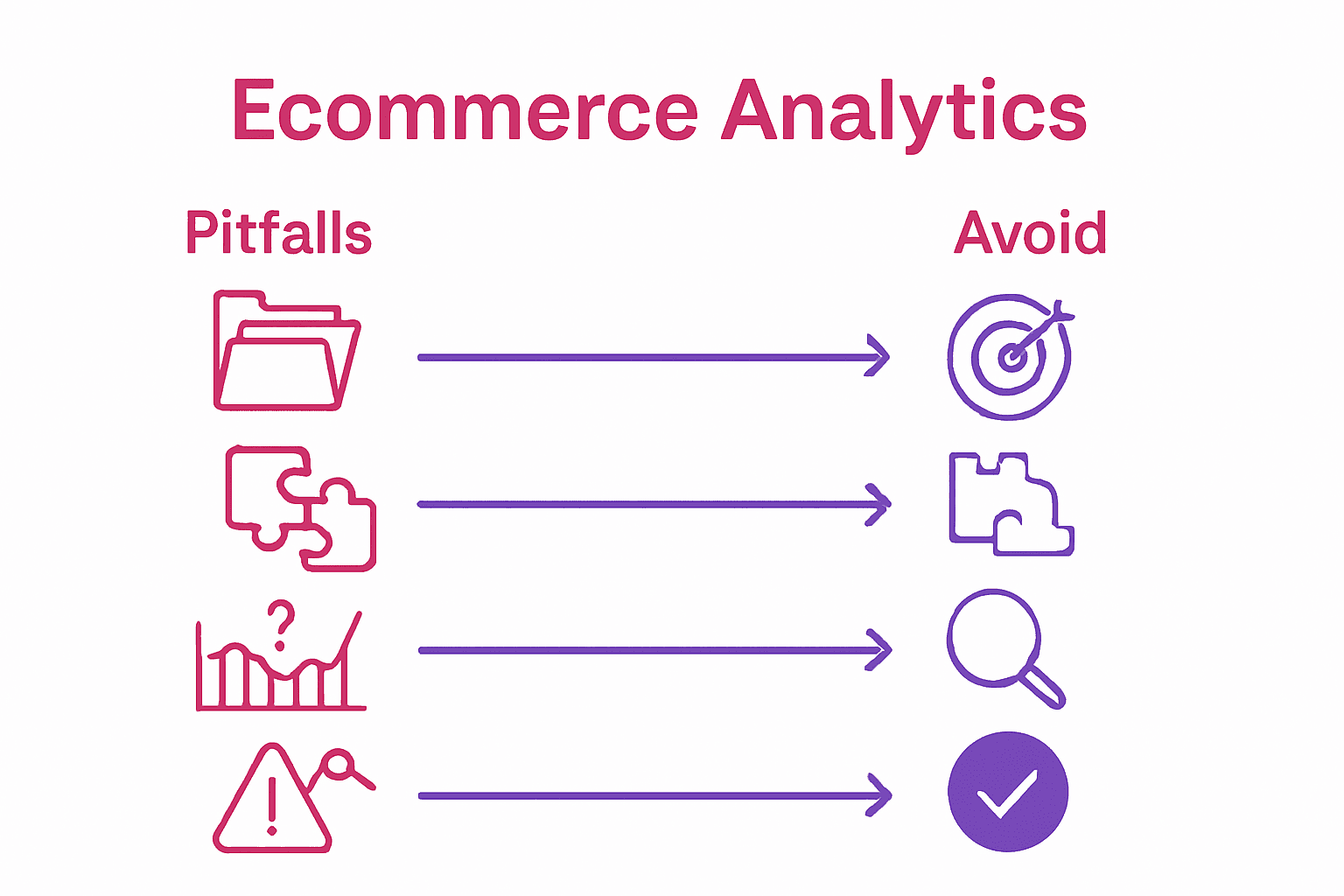
This means establishing clear protocols, regularly validating data sources, and maintaining a critical perspective when interpreting analytical insights.
For online retailers seeking to refine their analytical approach, Role of Social Media in Ecommerce: Complete Guide provides additional context on leveraging data effectively across different digital platforms.
Unlock the Full Potential of Your Ecommerce Analytics Today
Understanding ecommerce analytics is essential to avoid common pitfalls like data overload and misinterpreted metrics. This guide highlights how crucial clear objectives, accurate tools and reliable data are to transforming raw numbers into strategic insights that truly elevate your online business. If you find yourself struggling to turn complex analytics into actionable growth, you are not alone.
We specialise in delivering tailored digital marketing services including SEO, AI, Social Media and PPC designed specifically for ecommerce websites. With over 25 years of proven success scaling multiple online brands, our expertise helps bridge the gap between data and results. Discover how our approach can help you optimise key performance indicators such as conversion rates and customer lifetime value while avoiding costly mistakes.
Take control of your ecommerce future now and explore our comprehensive solutions at iwanttobeseen.online.

Ready to transform your analytics into increased sales and lasting customer loyalty? Visit our Ecommerce Advertising Guide and learn how expert strategies combined with data-driven insights can boost your online store’s performance. Start making smarter decisions today with our proven support and step confidently into 2025.
Frequently Asked Questions
What is ecommerce analytics?
Ecommerce analytics is the systematic process of gathering, measuring, and interpreting digital data related to online business performance. It helps businesses understand customer behaviour, predict market trends, optimize marketing strategies, and improve overall performance.
What are the key metrics to track in ecommerce analytics?
Key metrics include conversion rate, average order value, customer acquisition cost, cart abandonment rate, and customer lifetime value. These metrics provide insights into the health and performance of your online business.
How can I implement ecommerce analytics for my online store?
To implement ecommerce analytics, define clear objectives, select appropriate analytics tools, integrate data sources, establish baseline metrics, and develop regular reporting mechanisms to review performance consistently.
What common pitfalls should I avoid in ecommerce analytics?
Common pitfalls include data overload, incorrect tool selection, misinterpreting metrics, inconsistent tracking, and neglecting data quality. Avoiding these mistakes requires a disciplined approach to data collection and interpretation.
Recommended
Comments