.png)
Organic Search Explained: Impact on Ecommerce Growth


More than 60 percent of all online purchases in the United Kingdom begin with an unpaid search result. For British ecommerce business owners, mastering organic search is essential to reach customers who are actively searching for products instead of relying on costly advertising. This guide uncovers how understanding the principles of organic search can set your store apart, drawing qualified traffic and building lasting visibility in a competitive digital market.
Table of Contents
Key Takeaways
Point | Details |
Understanding Organic Search | Organic search results are unpaid and generated based on relevance and authority, focusing on delivering value to users without financial influence. |
Integrating Search Strategies | A balanced approach combining organic, paid, and local search enhances online visibility and customer acquisition for e-commerce businesses. |
Content and Technical Excellence | High-quality content and robust website performance are critical for improving organic search visibility and achieving higher search rankings. |
Adapting to Risks | E-commerce platforms must remain agile in responding to technological changes and algorithm updates, employing innovative strategies to mitigate risks. |
Organic search definition and core concepts
Organic search represents the unpaid search engine results that appear naturally based on their relevance and authority. Unlike paid advertisements, these results are generated by complex search engine algorithms that evaluate content quality, user intent, and website credibility. Organic search results are fundamentally about delivering the most pertinent information to users without financial influence.
At its core, organic search operates through sophisticated ranking mechanisms that assess multiple factors including content relevance, website structure, user engagement metrics, and overall domain authority. Search engines like Google analyse websites comprehensively, examining elements such as keyword usage, content depth, site loading speed, mobile responsiveness, and external link profiles to determine search rankings. This holistic approach ensures that the most valuable and trustworthy content rises to the top of search results.
For e-commerce businesses, understanding organic search is critical for sustainable online growth. Inbound marketing strategies that focus on organic search can generate long-term traffic, enhance brand visibility, and establish credibility without ongoing advertising expenditure. By creating high-quality, user-focused content that directly addresses customer queries and needs, online stores can improve their search engine positioning and attract more potential customers.
Pro tip: Invest time in creating comprehensive, value-driven content that genuinely answers user questions and provides unique insights into your products or industry.
Types of search: organic, paid, and local
Search marketing encompasses three distinct approaches: organic, paid, and local search, each serving unique strategic purposes for e-commerce businesses. Search strategies vary in their methodology, cost, and potential for generating online visibility and customer engagement.
Organic search represents unpaid, naturally ranked search results achieved through strategic content optimisation and search engine best practices. These results are earned by demonstrating relevance, quality, and authority to search algorithms. Businesses invest in search engine optimisation (SEO) techniques like creating high-quality content, improving website structure, and building credible backlink profiles to improve their organic search rankings.
Paid search involves sponsored advertisements that appear alongside organic results, typically marked with a small ‘Ad’ indicator. These results provide immediate visibility by allowing businesses to bid on specific keywords and target precise audience segments. While paid search delivers quick results, it requires continuous financial investment and stops generating traffic once advertising budgets are depleted. In contrast, local search focuses on geographical targeting, helping businesses with physical locations attract nearby customers through location-specific optimisation strategies.
The following table highlights differences among organic, paid, and local search approaches for e-commerce businesses:
Search Type | Main Focus | Cost Structure | Business Impact |
Organic | Unpaid relevance score | No direct cost | Sustainable growth |
Paid | Sponsored placement | Ongoing ad spend | Immediate visibility |
Local | Geographic optimisation | Minimal/additional | Attracts nearby buyers |
Pro tip: Develop a balanced search strategy that integrates organic, paid, and local search tactics to maximise your e-commerce website’s online visibility and customer acquisition potential.
How organic search drives ecommerce traffic
Organic search functions as a critical traffic generation mechanism for e-commerce businesses, delivering high-quality, targeted visitors who are actively seeking specific products or solutions. Why SEO matters fundamentally transforms how online stores attract and engage potential customers through strategic digital visibility.
Targeted traffic acquisition represents the primary mechanism through which organic search drives e-commerce growth. Unlike paid advertising channels, organic search delivers visitors with genuine purchase intent, resulting from their specific search queries matching a website’s content. Search engines interpret user intent, matching sophisticated algorithms with relevant product pages, category descriptions, and informative content that directly addresses customer needs.
The long-term value of organic search becomes evident through its compounding effects on brand credibility and customer trust. E-commerce websites that consistently produce high-quality, relevant content establish themselves as authoritative sources within their industry. This authority translates into higher search rankings, increased click-through rates, and ultimately, more qualified traffic that is more likely to convert into paying customers. Search algorithms reward websites that demonstrate expertise, relevance, and user engagement through comprehensive product descriptions, detailed buying guides, and customer-focused content strategies.
Pro tip: Create comprehensive, keyword-rich content that answers specific customer questions and demonstrates deep product knowledge to improve your organic search performance and attract more qualified traffic.
Key factors for successful organic visibility
Organic search visibility hinges on a sophisticated blend of technical, content, and strategic elements that work cohesively to improve a website’s search engine performance. Search engine optimization requires a comprehensive approach that goes far beyond simple keyword placement, demanding nuanced understanding of search algorithms and user behaviour.

Content quality emerges as the foundational pillar of organic visibility. Search engines prioritise websites that produce authoritative, original, and deeply informative content addressing user queries with precision. This means developing comprehensive product descriptions, creating detailed buying guides, publishing industry insights, and crafting content that genuinely solves customer problems. The most successful e-commerce platforms understand that content is not merely about selling products, but about providing genuine value that establishes trust and expertise.
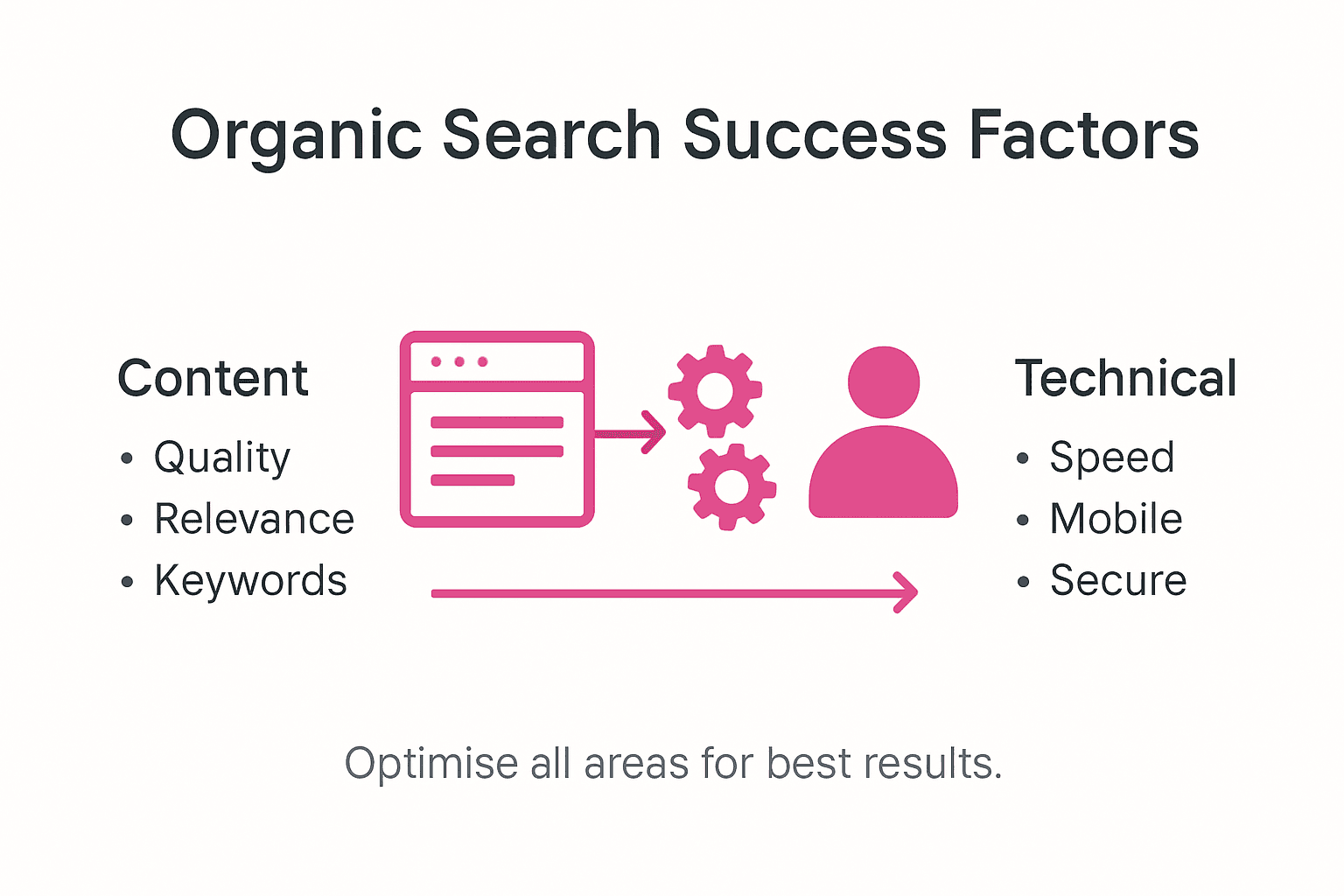
Technical infrastructure plays an equally critical role in organic search success. Website performance metrics such as page loading speed, mobile responsiveness, secure connections, and intuitive navigation directly influence search rankings. Search algorithms meticulously evaluate user experience, penalising websites with poor technical foundations and rewarding those that offer seamless, accessible digital experiences. Keyword research strategies become instrumental in understanding user intent, allowing businesses to align their technical optimization with precise customer search behaviours.
Here is a summary of the essential factors driving successful organic search visibility:
Factor | Description | Influence on SEO |
Content Quality | Detailed, authoritative, unique content | Improves trust ranking |
Technical Performance | Fast, mobile-friendly, secure website | Boosts user experience |
User Engagement | High interaction and satisfaction | Signals relevance to search engines |
Pro tip: Invest in creating a holistic SEO strategy that balances high-quality content, technical excellence, and user-centric design to consistently improve your organic search visibility.
Risks, challenges, and alternative approaches
Organic search strategies for e-commerce confrontfront multifaceted risks that demand sophisticated mitigation approaches. E-commerce search challenges encompass complex technological and strategic obstacles that require nuanced understanding and proactive management.
Technological vulnerabilities represent a significant risk landscape for organic search performance. Cybersecurity threats, algorithm volatility, and rapid technological shifts can dramatically impact search visibility. E-commerce platforms must continuously adapt to emerging search engine algorithms, privacy regulations, and user experience expectations. These challenges demand robust technical infrastructure, agile development strategies, and a commitment to maintaining cutting-edge digital capabilities that protect both user data and search engine rankings.
Alternative approaches to mitigating organic search risks involve strategic diversification and innovative technological interventions. Emerging technologies like artificial intelligence offer promising solutions for enhancing search query understanding, improving product relevance matching, and creating more personalised user experiences. By implementing machine learning algorithms, developing multi-modal search capabilities, and investing in advanced recommendation systems, e-commerce businesses can create more resilient and adaptive organic search strategies that anticipate and respond to dynamic market conditions.
Pro tip: Develop a flexible organic search strategy that integrates multiple technological approaches, continuously monitors performance metrics, and remains adaptable to emerging digital trends and search engine algorithm updates.
Elevate Your Ecommerce Growth with Expert Organic Search Strategies
Understanding the vital role that organic search plays in attracting targeted, high-quality ecommerce traffic is one thing. Overcoming challenges like algorithm changes and content quality demands is another. If your goal is to build sustainable online visibility through powerful SEO techniques that drive real results you need a partner with proven expertise in crafting holistic, data-driven strategies tailored specifically for ecommerce brands.

Unlock the full potential of your online store with our digital marketing services specialising in SEO, AI, Social Media, and PPC. With over 25 years of experience scaling multiple successful ecommerce brands, we help you conquer organic search complexities and achieve lasting growth. Visit our website to explore how our innovative solutions align with your ecommerce goals and let us help you dominate organic, paid, and local search channels. Don’t wait – take the first step toward sustainable ecommerce success now.
Frequently Asked Questions
What is organic search and how does it differ from paid search?
Organic search refers to unpaid search engine results that appear naturally based on their relevance and authority, unlike paid search, which involves sponsored advertisements that require a financial investment for visibility.
How does organic search influence e-commerce growth?
Organic search drives e-commerce growth by attracting high-quality, targeted traffic from users actively searching for specific products, thereby increasing brand credibility and potential customer conversion rates.
What key factors affect organic search visibility for e-commerce websites?
Key factors include content quality, technical performance of the website (including loading speed and mobile-friendliness), and user engagement metrics that collectively influence search engine rankings.
What are the risks associated with organic search strategies?
Risks include technological vulnerabilities such as algorithm changes, cybersecurity threats, and the need for continuous adaptation to user experience trends, which can affect search visibility and overall performance.
Recommended
Comments